Vegetos

(An International Journal of Plant Research & Biotechnology)
(eISSN: 2229-4473)
Diversity and management of home garden plants in two semi-urban administrative blocks of Assam, India
*Article not assigned to an issue yet
Research Articles | Published: 26 September, 2026
First Page: 0
Last Page: 0
Views: 127
Keywords: Dimoria, Hajo, Plant composition, Correlation, Relative occurrence
Abstract
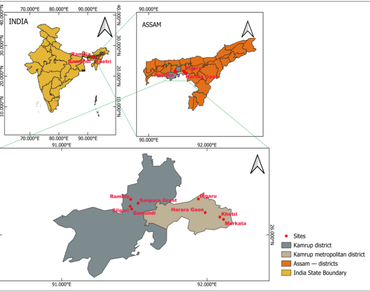
Traditional homegardens, locally known as “Baree” in Assam, are important ecological landscapes supporting household subsistence and income. This study examined plant diversity, composition, uses, and management of homegardens (HGs) in two semiurban blocks, Hajo and Dimoria, near Guwahati, capital city of Assam. Data were collected through semi-structured household surveys involving 40 randomly selected households from four villages in each block. Dimoria HGs were significantly larger (0.30 ha). A total of 110 plant species from 52 families were recorded, comprising 58 trees, 9 shrubs, 27 herbs, and 16 climbers. Species richness varied more widely among Hajo HGs (CV = 34.60%) than Dimoria (20.64%). Crop composition varied among households, influenced by urban market access, subsistence needs, and individual preferences. Promoting commercially valuable crops, along with skills in production, value addition, and marketing, could enhance HG profitability.
References
Abdoellah OS, Schneider M, Nugraha LM, Suparman Y, Voletta CT, Withaningsih S, Heptiyanggit A, Hakim L (2020) Homegarden commercialization: extent, household characteristics, and effect on food security and food sovereignty in Rural Indonesia. Sustain Sci 15(3):797–815. https://doi.org/10.1007/s11625-020-00788-9
Balooni K, Gangopadhyay K, Kumar BM (2014) Governance for private green spaces in a growing Indian city. Landsc Urban Plann 123:21–29. https://doi.org/10.1016/j.landurbplan.2013.12.004
Barbhuiya AR, Sahoo UK, Upadhyaya K (2016) Plant diversity in the indigenous home gardens in the eastern Himalayan region of Mizoram, Northeast India. Econ Bot 70:115–131. https://doi.org/10.1007/s12231-016-9349-8
Bhol N, Sarangi SK, Behera UK (2015) Coconut (Cocos nucifera)-based farming system: a viable land use option for small and marginal farmers in coastal Odisha. Indian J Agric Sci 85(11):1488–1497
Castañeda-Navarrete J (2023) Rural urbanisation and home gardening in southern Mexico: agrobiodiversity loss and alternative pathways. J Peasant Stud 50(3):1227–1248. https://doi.org/10.1080/03066150.2022.2101100
Das T, Das AK (2005) Inventorying plant biodiversity in homegardens: a case study in Barak Valley, Assam, North-East India. Curr Sci 89(1):155–163
Das SK, Deb S, Debnath B (2020) Assessment of plant diversity in homegardens of rural and urban areas of Tripura, North-East India. Indian J Agrofor 22(2):71–79
FSI (2017) India State of Forest Report 2017. Ministry of Environment, Forest and Climate Change, Government of India, Dehradun. https://fsi.nic.in/isfr2017/isfr-forest-cover-2017.pdf
Galhena DH, Freed R, Maredia KM (2013) Home gardens: a promising approach to enhance household food security and wellbeing. Agric Food Secur 2(1):1–13. https://doi.org/10.1186/2048-7010-2-8
Galluzzi G, Eyzaguirre P, Negri V (2010) Home gardens: neglected hotspots of agro-biodiversity and cultural diversity. Biodivers Conserv 19(13):3635–3654. https://doi.org/10.1007/s10531-010-9919-5
Gebremariam MS, Alito TA, Fakana ST (2025) Contribution of homegarden agroforestry to adaptation strategy of climate change in Boloso Sore Woreda, Wolaita zone, South Ethiopia. Discov Environ 3:157. https://doi.org/10.1007/s44274-025-00352-1
González-Ball R, Bermúdez-Rojas T, Romero M (2017) Floristic composition and richness of urban domestic gardens in three urban socioeconomic stratifications in the city Heredia, Costa Rica. Urban Ecosyst. https://doi.org/10.1007/s11252-016-0587-4
Hussain Z, Majumder SH, Deka N (2025) Assessing the status of home garden biodiversity in Assam, India: an economic perspective. Agroforest Syst 99:226. https://doi.org/10.1007/s10457-025-01314-5
Kanjilal UN, Kanjilal PC, Das A, De RN, Bor NL (1934) Flora of Assam, vol Vols. 1–5. Published under the authority of the Government of Assam, Shillong
Konyak T, Kumar H, Kumari R, Umrao R (2022) Impact of traditional home garden on socio-economy across altitudinal gradient of Mon District in Nagaland. Emerg Life Sci Res. https://doi.org/10.31783/elsr.2022.81104113
Majumdar PK, Dolui DK, Banerjee HK (2001) Agricultural modernization, child labour and fertility: rural West Bengal, India. Paper presented at the International Union for the Scientific Study of Population; August 24; Salvador, Brazil.
Marak N, Upadhyaya K, Nongtri A, Lyngdoh N (2023) Plant species composition and product utility pattern of Garo homegardens in Meghalaya, India. J Appl Nat Sci. https://doi.org/10.31018/jans.v15i2.4099
Mbow C, Smith P, Skole D, Duguma L, Bustamante M (2014) Achieving mitigation and adaptation to climate change through sustainable agroforestry practices in Africa. Curr Opin Environ Sustain 6:8–14. https://doi.org/10.1016/j.cosust.2013.09.002
Mitchell R, Hanstad T (2004) Small homegarden plots and sustainable livelihoods for the poor. FAO LSP WP 11:41
Nair PKR, Kumar BM, Nair VD (2021) Definition and concepts of agroforestry. An introduction to agroforestry: four decades of scientific developments. Springer International Publishing, Cham, pp 21–28. https://doi.org/10.1007/978-3-030-75358-0_2
Ogutu SO, Mockshell J, Garrett J, Labarta R, Ritter T, Martey E, Nedumaran S, Elissabetta G, Carolina G (2023) Home gardens, household nutrition and income in rural farm households in Odisha, India. J Agric Econ 74:744–763. https://doi.org/10.1111/1477-9552.12525
Pebam R, Sahoo U (2018) Traditional homegardens of Mizoram and their socio-economic development. In: Forests, climate change and biodiversity. Kalyani Publisher, New Delhi, 102–126.
Sahoo U, Pebam R (2015) Species composition and plant diversity as influenced by altitude and size of homegardens in Mizoram, North-East India. Int J Ecol Environ Sci 41:195–215
Saikia P, Khan ML (2014) Homegardens of upper Assam, northeast India: a typical example of on farm conservation of Agarwood (Aquilaria malaccensis Lam.). Int J Biodivers Sci Ecosyst Serv Manag 10(4):262–269. https://doi.org/10.1080/21513732.2014.973449
Sharma R, Mina U, Kumar BM (2022) Homegarden agroforestry systems in achievement of Sustainable Development Goals. A review. Agron Sustain Dev 42(3):44. https://doi.org/10.1007/s13593-022-00781-9
Shimrah T, Lungleng P, Shimrah C, Khuman YSC, Varah F (2018) Role of traditional homegardens in biodiversity conservation and socioecological significance in Tangkhul community in Northeast India. Trop Ecol 59:533–539
Tynsong H, Tiwari B (2009) Plant diversity in the homegardens and their significance in the livelihoods of War Khasi Community of Meghalaya, North-east India. J Biodivers. https://doi.org/10.1080/09766901.2010.11884713
Van NM, Duguma LA, Dewi S, Leimona B, Catacutan DC, Lusiana B, Öborn I, Hairiah K, Minang PA (2018) SDG synergy between agriculture and forestry in the food, energy, water and income nexus: reinventing agroforestry? Curr Opin Environ Sustain 34:33–42. https://doi.org/10.1016/j.cosust.2018.09.003
Whitney CW, Luedeling E, Tabuti JR, Nyamukuru A, Hensel O, Gebauer J, Kehlenbeck K (2018) Crop diversity in homegardens of south- west Uganda and its importance for rural livelihoods. Agr Human Values 35(2):399–424. https://doi.org/10.1007/s10460-017-9835-3
World Bank Publications (2008) World Development Report: Agriculture for Development. Washington, D.C.
Sharma R, Mina U, Devi A, Kumar BM (2024) Do homegardens act as agent of agrobiodiversity conservation: a case study of homegardens of diverse socio-ecological zones in the Brahmaputra Valley, Assam. Front Sustain Food Syst 8:1366499. https://doi.org/10.3389/fsufs.2024.1366499
Fernandes ECM, Nair PKR (1986) An evaluation of the structure and function of tropical homegardens. Agric Syst 21:279–310
Author Information
Department of Environmental Science, School of Earth Sciences and Natural Resources Management, Mizoram University, Aizawl, India