Vegetos

(An International Journal of Plant Research & Biotechnology)
(eISSN: 2229-4473)
Influence of extraction technique on the chemical constituents and therapeutic potential of betel leaf essential oil
*Article not assigned to an issue yet
Soren Priyanka Priyadarshini, Jaiswal Nikita, Mohanty Alaka, Sahoo Rajesh Kumar, Sahoo Ambika, Nayak Sanghamitra, Mohanty Sujata
Research Articles | Published: 19 September, 2026
First Page: 0
Last Page: 0
Views: 125
Keywords: n Piper betlen , Hydro distillation, Solvent free microwave extraction, GC-MS, Bioactivity
Abstract
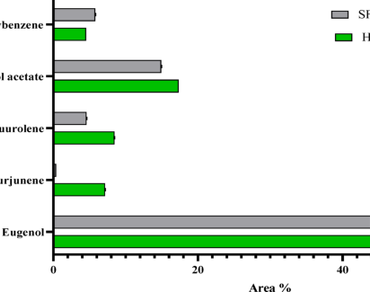
Plant essential oils are widely used in health care and naturopathy due to their therapeutic properties, offering natural alternatives for physical and emotional well-being. The present study aimed to compare solvent-free microwave extraction (SFME) and hydro-distillation extraction (HD) methods for analyzing the efficiency of Piper betle leaf essential oil (PBLEO). SFME was found to be more competent than HD in terms of oil yield and preserving the bioactive potential of PBLEO. A total of 53 and 27 phytoconstituents were identified in PBLEO extracted through SFME and HD methods, respectively. The PBLEO extracted through the SFME method, dominated by monoterpenes and sesquiterpenes classes of phytoconstituents, showed better antioxidant and anti-tyrosinase activity with lower IC50 values along with better anti-microbial activity than oil extracted through HD. The current results suggested that the SFME method, which is fast, green, and energy-saving could be a better alternative for the production of essential oils with bioactive potential for application in food and pharmaceutical industries.
References
Adams RP (2007) Identification of essential oil components by gas chromatography/mass spectroscopy, 4th edn. Allured Publishing Corporation, Illinois
Akloul R, Benkaci-Ali F, Eppe G (2014) Kinetic study of volatile oil of Curcuma longa L. rhizome and Carum carvi L. fruits extracted by microwave-assisted techniques using the cryogrinding. J Essent Oil Res 26:473–485. https://doi.org/10.1080/10412905.2014.942766
Alam MB, Park NH, Song BR, Lee SH (2023) Antioxidant potential-rich betel leaves (Piper betle L.) exert depigmenting action by triggering autophagy and downregulating MITF/tyrosinase in vitro and in vivo. Antioxidants 12:374. https://doi.org/10.3390/antiox12020374
Berka-Zougali B, Ferhat MA, Hassani A, Chemat F, Allaf KS (2012) Comparative study of essential oils extracted from Algerian Myrtus communis L. leaves using microwaves and hydrodistillation. Int J Mol Sci 13:4673–4695. https://doi.org/10.3390/ijms13044673
Chao WW, Su CC, Peng HY, Chou ST (2017) Melaleuca quinquenervia essential oil inhibits-melanocyte-stimulating hormone induced melanin production and oxidative stress in B16 melanoma cells. Phytomedicine 34:191–201. https://doi.org/10.1016/j.phymed.2017.08.024
Das S, Sandeep IS, Mohapatra P, Kar B, Sahoo RK, Subudhi E, Nayak S, Mohanty S (2022) A comparative study of essential oil profile, antibacterial and antioxidant activities of thirty Piper betle landraces towards selection of industrially important chemotypes. Ind Crop Prod 187:115289. https://doi.org/10.1016/j.indcrop.2022.115289
Djouahri A, Boudarene L, Meklati BY (2013) Effect of extraction method on chemical composition, antioxidant and anti-inflammatory activities of essential oil from the leaves of Algerian Tetraclinis articulata (Vahl) Masters. Ind Crop Prod 44:32–36. https://doi.org/10.1016/j.indcrop.2012.10.021
Friedman M, Henika PR, Mandrell RE (2002) Bactericidal activities of plant essential oils and some of their isolated constituents against Campylobacter jejuni, Escherichia coli, Listeria monocytogenes, and Salmonella enterica. J Food Prot 65:1545–1560. https://doi.org/10.4315/0362-028X-65.10.1545
Guha P, Khan S, Zari SR (2017) Comparative study of microwave assisted hydro-distillation with conventional hydro-distillation for extraction of essential oil from Piper betle L. Biosci Biotechnol Res Asia 14:401–407. https://doi.org/10.13005/bbra/2458
Gupta RK, Guha P (2024) Effect of ultrasonic pretreatment on yield and properties of essential oil of betel leaf (Piper betle L). Chem Afr 7:79–92
Liu Z, Li H, Zhu Z, Huang D, Qi Y, Ma C, Zou Z, Ni H (2022) Cinnamomum camphora fruit peel as a source of essential oil extracted using the solvent-free microwave-assisted method compared with conventional hydrodistillation. Lwt 153:112549. https://doi.org/10.1016/j.lwt.2021.112549
Marques SDPPM, Pinheiro RO, Nascimento RAD, Andrade EHDA, Faria LJGD (2023) Effects of harvest time and hydrodistillation time on yield, composition, and antioxidant activity of mint essential oil. Molecules 28:7583. https://doi.org/10.3390/molecules28227583
Mohanty A, Mohanta O, Sahoo RK, Nayak S, Panda PC, Mohanty S (2025) Chemical profiling, antioxidant, antimicrobial and antibiofilm activities of Vitex pinnata leaf essential oil: a rare species. Plant Biosyst 159(6):1474–1483. https://doi.org/10.1080/11263504.2025.2541737
Mohanty S, Ray A, Naik PK, Sahoo A, Jena S, Das PK, Patnaik J, Panda PC, Nayak S (2023) Variation in yield, chemical composition and biological activities of essential oil of three curcuma species: a comparative evaluation of hydrodistillation and solvent-free microwave extraction methods. Molecules 28:4434. https://doi.org/10.3390/molecules28114434
Okoh OO, Sadimenko AP, Afolayan AJ (2010) Comparative evaluation of the antibacterial activities of the essential oils of Rosmarinus officinalis L. obtained by hydrodistillation and solvent free microwave extraction methods. Food Chem 120:308–312. https://doi.org/10.1016/j.foodchem.2009.09.084
Qiu Y, Wang Y, Li Y (2022) Solvent-free microwave extraction of essential oils from Litsea cubeba (Lour.) Pers. at different harvesting times and their skin-whitening cosmetic potential. Antioxidants 11:2389. https://doi.org/10.3390/antiox11122389
Row LCM, Ho JC (2013) The antimicrobial activity, mosquito larvicidal activity, antioxidant property and tyrosinase inhibition of Piper betle. J Chin Chem Soc 56:653–658. https://doi.org/10.1002/jccs.200900097
Saxena M, Khare NK, Saxena P, Syamsundar KV, Srivastava SK (2014) Antimicrobial activity and chemical composition of leaf oil in two varieties of Piper betle from northern plains of India. J Sci Ind Res 73:95–99
Suppakul P, Sanla-Ead N, Phoopuritham P (2006) Antimicrobial and antioxidant activities of betel oil. Agr Nat Resour 40:91–100
Van den Dool H, Kratz PD (1963) A generalization of the retention index system including linear temperature programmed gas-liquid partition chromatography. J Chromatogr 11:463–471
Author Information
Department of Biotechnology, Rama Devi Women’s University, Bhubaneswar, India