Vegetos

(An International Journal of Plant Research & Biotechnology)
(eISSN: 2229-4473)
Hyptis brevipes (Lamiaceae), Richardia brasiliensis (Rubiaceae) and Spermacoce remota (Rubiaceae): First record of naturalized status in Nepal
*Article not assigned to an issue yet
Research Articles | Published: 22 June, 2026
First Page: 0
Last Page: 0
Views: 108
Keywords: Alien species, Botanical exploration, Flora of Nepal, Tarai flora
Abstract
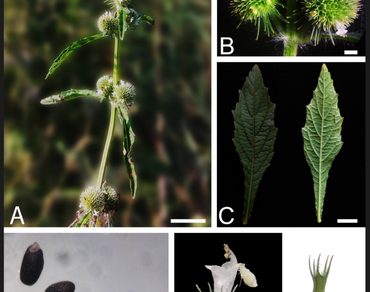
Naturalized status of three alien plant species, namely Hyptis brevipes Poit. (Lamiaceae), Richardia brasiliensis Gomez (Rubiaceae) and Spermacoce remota Lam. (Rubiaceae) has been reported for the first time in Nepal based on the field survey and specimen collections from Jhapa and Morang districts of eastern Nepal. Along with taxonomic account, we also present distinguishing features, supported by their photographs and extent of occurrence of each species.
References
Adhikari B, Poudel YB, Parmar G, Sharma LN, Poulsen AD (2023) A report on the plant collecting fieldwork in Jalthal forest, eastern Nepal, with four new records to the flora of Nepal. Newsl Himal Bot 53:1–8
Bachman S, Moat J, Hill AW, De la Torre J, Scott B (2011) Supporting Red List threat assessments with GeoCAT: geospatial conservation assessment tool. In: Smith V, Penev L (eds) Infrastructures for data publishing in biodiversity science. Zookey, Pensoft, Sofia, Bulgaria, pp 117–126
Bhandari P, Li BZ, Kunwar A, Poudel S, Zhou SL, Zhang SR (2024) Taxonomic study of pan-himalayan Cyperus species which used to be placed in the segregate genus Pycreus. Phytotaxa 638(2):105–130. https://doi.org/10.11646/phytotaxa.638.2.1
Bhandari P (2024) Angiosperm diversity in Nepal. In: Rokaya MB, Sigdel SR (eds) flora and vegetation of Nepal, 19th volume edn. Springer, Cham, Switzerland, pp 279–298. https://doi.org/10.1007/978-3-031-50702-1_11
Blackburn TM, Pyšek P, Bacher S, Carlton JT, Duncan RP, Jarošík V, Wilson JRU, Richardson DM (2011) A proposed unified framework for biological invasions. Trends Ecol Evol 26(7):333–339. https://doi.org/10.1016/j.tree.2011.03.023
CABI (2022) Richardia brasiliensis (White-eye (Australia)). CABI compendium, p 31383. https://doi.org/10.1079/cabicompendium.31383
Davies NM, Drinkell C, Utteridge TM (2023) The Herbarium Handbook: sharing best practice from across the globe. Kew Publishing, Royal Botanic Gardens, Kew
GBIF.org (2025) GBIF Home Page. Available from: https://www.gbif.org [31 March 2025]
Gomes BA (1801) Memoria sobre a ipecacuanha fusca do Brasil, ou cipo das nossas boticas. Impressa de ordem de S. Altezza Real o Principe Regente Nosso Senhor. Typografia Chalcographica, Typoplastica e Litteraria do Arco do Cego, Lisbon. (in Portuguese)
Gulzar R, Wani SA, Hassan T, Reddy CS, Shrestha BB, Mukul SA, Shabbir A, Iqbal IM, Ranwala SMW, Sujanapal DP, Rashid I, Khuroo AA (2024) Looking beyond the political boundaries: an integrated inventory of invasive alien flora of South Asia. Biol Invasions 26(1):57–78. https://doi.org/10.1007/s10530-023-03165-6
Holm L, Pancho JV, Herbergo JP, Plucknett DL (1979) A geographical atlas of world weeds. Wiley, New York
Inderjit PJ, van Kleunen M, Hejda M, Babu CR, Majumdar S, Singh M, Singh SP, Salamma S, Rao BRP, Pyšek P (2018) Naturalized alien flora of the Indian states: biogeographic patterns, taxonomic structure and drivers of species richness. Biol Invasions 20(6):1625–1638. https://doi.org/10.1007/s10530-017-1622-y
Jaryan V, Uniyal SK, Kumar A, Gupta RC, Singh RD (2013) Extent of occurrence and area of occupancy of tallow tree (Sapium sebiferum): using the red list criteria for documenting invasive species expanse. Natl Acad Sci Lett 36:85–91
Kostermans AJGH, Wirjahardja S, Dekker RJ (1987) The weeds: description, ecology and control. In: Soerjani M, Kostermans AJGH, Tjitrosoepomo G (eds) weeds of rice in Indonesia. Balai Pustaka, Jakarta, Indonesia, pp 24–565
Lamarck JBPAD, Poiret JLM (1791) Tableau encyclopédique et méthodique des trois règnes de la nature. Botanique 1(2):273 (in French)
Lewis WH, Oliver RL (1974) Revision of Richardia (Rubiaceae). Brittonia 26(3):271–301
Li HW, Hedge IC (1994) Lamiaceae. In: Wu CY, Raven PH (eds) Flora of China, 17th volume edn. Science Press; Missouri Botanical Garden, Beijing, pp 50–299
Lorenzi H (1982) Plantas Daninhas do Brasil. Plantarum, Brazil. (in Portuguese)
Narashimhan D, Nehru P (2011) Spermacoce remota Lam. (Rubiaceae) – A potential invasive weed of wetlands. J Economic Taxonomic Bot 35(4):645–647
Nayar JS, Beegam AR, Mohanan NN, Rajkumar G (2006) Flowering plants of Kerala. Tropical Botanic Garden and Research Institute (IBGRI), Palode, Thiruvanathapuram
Neupane A, Adhikari B, Shrestha BB (2024) Cuphea carthagenensis (Jacquin) JF Macbride, Lythraceae: a newly naturalised species from eastern Nepal. Check List 20(1):40–46. https://doi.org/10.15560/20.1.40
Ojha R, Poudel YB, Poudel S, Shah S, Bashyal S, Pandey N, Bhandari P (2023) Addition of two species of Cyperus (Cyperaceae) to the Flora of Nepal. J Japanese Bot 98(5):271–274. https://doi.org/10.51033/jjapbot.ID0140
PIER (2010) Richardia brasiliensis. http://www.hear.org/pier/species/richardia_brasiliensis.htm (accessed on 29 Jun. 2025)
PIER (2017) Pacific islands ecosystem at risk. HEAR, University of Hawaii, Honolulu
POWO, the World Online (2025) Plants of (2025) Facilitated by the royal botanic gardens, Kew. http://www.plantsoftheworldonline.org (accessed on 29 Jun. 2025)
Pandey N, Ghimire SK, Paudel HR (2021) Aeschynomene americana (Fabaceae)-a new naturalized record for the Flora of Nepal. J Japanese Bot 96(3):183–185
Parker C, Acevedo-Rodriguez P (2017) Hyptis brevipes (lesser roundweed). CABI compendium. https://doi.org/10.1079/cabicompendium.27851
Paul TK, Kumar A (2012) Extended distribution of Hyptis brevipes Poit. in India. Indian J For 35(1):101–102
Poiteau P (1806) Monographie du genre Hyptis. Ann du Muséum d’Histoire Naturelle Paris 7:459–477 (in French)
Poudel YB, Panthi K, Adhikari B, Rajbhandary S (2024) Lindernia rotundifolia (Linderniaceae), Picria fel-terrae (Linderniaceae), and Limnophila aromatica (Plantaginaceae): three new records for the flora of Nepal. Check List 20(3):819–827. https://doi.org/10.15560/20.3.819
Richardson DM, Pyšek P, Rejmanek M, Barbour MG, Panetta FD, West CJ (2000) Naturalization and invasion of alien plants: concepts and definitions. Divers Distrib 6(2):93–107
Rodríguez-Casal A, Saavedra-Nieves P (2022) Spatial distribution of invasive species: an extent of occurrence approach. Test 31(2):416–441. https://doi.org/10.1007/s11749-021-00783-x
Santamarina S, Mateo RG, Alfaro-Saiz E, Acedo C (2023) On the importance of invasive species niche dynamics in plant conservation management at large and local scale. Front Ecol Evol 10:1049142. https://doi.org/10.3389/fevo.2022.1049142
Sharma LN, Adhikari B, Bist MR, Shrestha BB (2020) Mimosa diplotricha (Fabaceae): A new report of invasive weed from Eastern Tarai of Nepal. J Plant Resour 18(1):1–5
Shrestha KK, Bhandari P, Bhattarai S (2022) Plants of Nepal: Gymnosperms and Angiosperms. Heritage Publishers and Distributors Pvt. Limited, Kathmnadu, Nepal
Shrestha BB, Chaudhary T, Shrestha UB, Devkota A, Sharma HP (2025) To what extent are Nepal’s protected areas protected from plant invasions: an analysis of threats. Biol Invasions 27(1):32. https://doi.org/10.1007/s10530-024-03495-z
Tao C, Taylor CM (2011) Richardia Linnaeus. In: Wu CY, Raven PH (eds) Flora of China, 19th volume edn. Science Press; Missouri Botanical Garden, Beijing, pp 302–303
Verma RK, Khan BA, Wagh VV, Meena B, Behera SK, Tamta S, Chaudhary LB (2022) Notes on the distribution of an alien weed Hyptis brevipes (Lamiaceae) in India. Plant Sci Today 9(1):1–4. https://doi.org/10.14719/pst.1421
Waterhouse DF (1993) The major Arthropods pests and weed of agriculture in South East Asia. Distribution importance and origin. Australian centre for International Agriculture Research, Canberra, Australia
Ojha R, Rai S, Schneider H (2025) Typhonium morangens e (Araceae), a new species from the tropical forest of Eastern Nepal. PhytoKeys 252:1–7. https://doi.org/10.3897/phytokeys.252.134081
Author Information
Department of Botany, Mechi Multiple Campus, Tribhuvan University, Bhadrapur, Nepal