Vegetos

(An International Journal of Plant Research & Biotechnology)
(eISSN: 2229-4473)
Phytochemistry of Aloysia citrodora and its insecticidal, herbicidal, and toxic activities
*Article not assigned to an issue yet
Research Articles | Published: 19 May, 2026
First Page: 0
Last Page: 0
Views: 79
Keywords: n Aloysia citrodoran , Verbenaceae, Insecticidal activity, Herbicidal activity, Natural products, Essential oils
Abstract
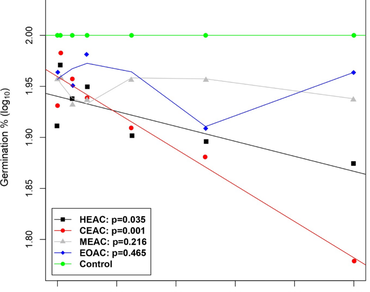
This study investigated the preliminary phytochemical composition of the chloroform extract from the leaves of lemon verbena (Aloysia citrodora Paláu; Verbenaceae) and evaluated the insecticidal, herbicidal, and toxicological activities of its extracts, as well as its essential oil. The toxicity assays using the Artemia spp. model indicated slight to moderate toxicity. Some extracts exhibited herbicidal activity at high concentrations, while promoting growth at lower concentrations. In insecticidal tests against the fruit fly Drosophila melanogaster, no significant mortality was observed; however, the methanolic extract showed approximately 85% hatch inhibition at concentrations greater than 500 ppm. Results demonstrated promising herbicidal activity at high concentrations, suggesting their potential use as natural weed control agents in agricultural systems; however, careful concentration management will be crucial to avoid unintended effects.
References
Abubakar Y, Tijjani H, Egbuna C, Adetunji CO, Kala S, Kryeziu TL, Ifemeje JC, Patrick-Iwuanyanwu KC (2020) Pesticides, history, and classification. Natural remedies for pest, disease and weed control. Elsevier, Amsterdam, pp 29–42
Alijar Souza M, Petry F, Vidor Morgan L, Dal Magro J, Müller LG (2022) Biological properties of Aloysia gratissima (Gillies & Hook.) Tronc. (Verbenaceae). Evid Based Complem Altern Med 2022:1119435. https://doi.org/10.1155/2022/1119435
Anandharaj B, Sathya M, Maheshwari M, Priyadharshini B, Ph VPA.D R (2021) Preliminary phytochemical screening of natural anti-dandruff plant Phylanodiflora (L.) Greene (Lippianodiflora). Int J Res Public Rev 2:1930–1932
Arena JS, Merlo C, Defagó MT, Zygadlo JA (2020) Insecticidal and antibacterial effects of some essential oils against the poultry pest Alphitobius diaperinus and its associated microorganisms. J Pest Sci 93:403–414. https://doi.org/10.1007/s10340-019-01141-5
Baloch IB, Baloch MK, Saqib QNU (2008) Anti-tumor 12-deoxyphorbol esters from Euphorbia cornigera. Eur J Med Chem 43:274–281. https://doi.org/10.1016/j.ejmech.2007.03.016
Bedir E, Karakoyun Ç, Doğan G, Kuru G, Küçüksolak M, Yusufoğlu H (2021) New cardenolides from biotransformation of gitoxigenin by the endophytic fungus Alternaria eureka 1E1BL1: characterization and cytotoxic activities. Molecules 26:3030. https://doi.org/10.3390/molecules26103030
Benzi V, Stefanazzi N, Murray AP, Werdin González JO, Ferrero A (2014) Composition, repellent, and insecticidal activities of two South American plants against the stored grain pests Tribolium castaneum and Tribolium confusum (Coleoptera: Tenebrionidae). ISRN Entomol 2014:1–5. https://doi.org/10.1155/2014/175827
Benzi VS, Murray AP, Ferrero AA (2009) Insecticidal and insect-repellent activities of essential oils from verbenaceae and anacardiaceae against Rhizopertha dominica. Nat Prod Commun 4:1934578X0900400926. https://doi.org/10.1177/1934578X0900400926
Camilo CJ, Leite DOD, da Mendes S, Dantas JW, de Carvalho AR, Castro NKG, Salazar JWG, Ferreira GJT, de Meneses MKA, da Silva JEA, dos Santos AW, Tavares HS, Silva JF, e JPR, Rodrigues FFG, Cheon C, Kim B, da Costa JGM (2022) Analysis toxicity by different methods and anxiolytic effect of the aqueous extract Lippia sidoides Cham. Sci Rep 12:20626. https://doi.org/10.1038/s41598-022-23999-9
Corzo FL, Traverso L, Sterkel M, Benavente A, Ajmat MT, Ons S (2020) Plodia interpunctella (Lepidoptera: Pyralidae): intoxication with essential oils isolated from Lippia turbinata (Griseb.) and analysis of neuropeptides and neuropeptide receptors, putative targets for pest control. Arch Insect Biochem Physiol 104:e21684. https://doi.org/10.1002/arch.21684
Curl CL, Spivak M, Phinney R, Montrose L (2020) Synthetic pesticides and health in vulnerable populations: agricultural workers. Curr Envir Health Rpt 7:13–29. https://doi.org/10.1007/s40572-020-00266-5
De Almeida LFR, Frei F, Mancini E, De Martino L, De Feo V (2010) Phytotoxic activities of mediterranean essential oils. Molecules 15:4309–4323. https://doi.org/10.3390/molecules15064309
Descamps LR, Sánchez-Chopa C (2019) Evaluación de la acción insecticida de aceites esenciales en larvas de Plutella xylostella (Lepidoptera: Plutellidae). Dominguezia 35:35–38
Domínguez XA (1979) Métodos de Investigación Fitoquímica = Phytochemical Research Methods, 1a reimpresión. Editorial Limusa, México
Evans FJ (1986) Phorbol: its esters and derivatives. In: Naturally occurring phorbol esters, 1st Edition. CRC Press, Boca Raton, p 320
Gleiser RM, Bonino MA, Zygadlo JA (2011) Repellence of essential oils of aromatic plants growing in Argentina against Aedes aegypti (Diptera: Culicidae). Parasitol Res 108:69–78. https://doi.org/10.1007/s00436-010-2042-4
Goel G, Makkar HPS, Francis G, Becker K (2007) Phorbol esters: structure, biological activity, and toxicity in animals. Int J Toxicol 26:279–288. https://doi.org/10.1080/10915810701464641
Golmakani M-T, Farahmand M, Ghassemi A, Eskandari MH, Niakousari M (2017) Enrichment of citral isomers in different microwave-assisted extraction of essential oil from fresh and dried lemon verbena (Aloysia citridora) leaves. J Food Process Preserv 41:e13215. https://doi.org/10.1111/jfpp.13215
Juárez ZN, Bach H, Sánchez-Arreola E, Bach H, Hernández LR (2016) Protective antifungal activity of essential oils extracted from Buddleja perfoliata and Pelargonium graveolens against fungi isolated from stored grains. J Appl Microbiol 120:1264–1270. https://doi.org/10.1111/jam.13092
Khani A, Rakhshani E, Basavand F, Rakhshani E (2012) Chemical composition and insecticide activity of lemon verbena essential oil. J Crop Prot 1:313–320. https://doi.org/10.48311/jcp.2012.1059
Mahdavi V, Rafiee-Dastjerdi H, Asadi A, Razmjou J, Achachlouei BF (2022) Evaluation of Lippia citriodora essential oil nanoformulation against the lepidopteran pest Phthorimaea operculella Zeller (Gelechiidae). Int J Pest Manage 68:113–123. https://doi.org/10.1080/09670874.2020.1800859
Makarova MN, Shikov AN, Avdeeva OI, Pozharitskaya ON, Makarenko IE, Makarov VG, Djachuk GI (2011) Evaluation of acute toxicity of betulin. Planta Med 77:PM48. https://doi.org/10.1055/s-0031-1282806
Małaczewska J, Kaczorek-Łukowska E, Kazuń B (2021) High cytotoxicity of betulin towards fish and murine fibroblasts: Is betulin safe for nonneoplastic cells? BMC Vet Res 17:198. https://doi.org/10.1186/s12917-021-02905-x
Marchev AS, Yordanova ZP, Georgiev MI (2020) Green (cell) factories for advanced production of plant secondary metabolites. Crit Rev Biotechnol 40:443–458. https://doi.org/10.1080/07388551.2020.1731414
Mazzuca M, Berezosky J, Cerdá RC, Arce ME, van Baren C, Lira PDL, Bandoni A (2011) Chemical composition and bioactivity of Acantholippia seriphioides essential oils from Patagonia. J Essent Oil Res 23:26–31. https://doi.org/10.1080/10412905.2011.9700453
Oliva M, de las M, Gallucci N, Zygadlo JA, Demo MS (2007) Cytotoxic activity of Argentinean essential oils on Artemia salina. Pharm Biol 45:259–262. https://doi.org/10.1080/13880200701214557
Olivero-Verbel J, Güette-Fernandez J, Stashenko E (2009) Acute toxicity against Artemia franciscana of essential oils isolated from plants of the genus Lippia and Piper collected in Colombia. Boletín Latinoamericano y del Caribe de Plantas Medicinales y Aromáticas 8:419–427
R Core Team (2024) R: A Language and. Environment for Statistical Computing
Ragone MI, Sella M, Conforti P, Volonté MG, Consolini AE (2007) The spasmolytic effect of Aloysia citriodora, Palau (South American cedrón) is partially due to its vitexin but not isovitexin on rat duodenums. J Ethnopharmacol 113:258–266. https://doi.org/10.1016/j.jep.2007.06.003
Rani L, Thapa K, Kanojia N, Sharma N, Singh S, Grewal AS, Srivastav AL, Kaushal J (2021) An extensive review on the consequences of chemical pesticides on human health and environment. J Clean Prod 283:124657. https://doi.org/10.1016/j.jclepro.2020.124657
Romano E, Raschi AB, González AM, Jaime G, Fortuna MA, Hernández LR, Bach H, Benavente AM (2011) Phytotoxic activities of (2R)-6-hydroxytremetone. Plant Physiol Biochem 49:671–675. https://doi.org/10.1016/j.plaphy.2011.02.014
Sánchez L, Neira A (2005) Bioensayo general de letalidad en Artemia salina, a las fracciones del extracto etanólico de Psidium guajava. L y Psidium guineense Sw. Cultura Científica 2005:40–45
Sánchez-Chopa C, Descamps LR (2015) Toxicidad de aceites esenciales de Verbenaceas sobre adultos de Diuraphis noxia (Hemiptera: Aphididade). Dominguezia 31:31–36
Santos DR, Oliveira LM, Lucchese AM, Espeleta AF, Cauz JD, Lordelo MS (2020) Insecticidal activity of essential oils of species from the genus Lippia against Nasutitermes corniger (Motschulsky) (Isoptera: Termitidae). Sociobiology 67:292–300. https://doi.org/10.13102/sociobiology.v67i2.4992
Schmidt RJ, Evans FJ (1980) Skin irritant effects of esters of phorbol and related polyols. Arch Toxicol 44:279–289. https://doi.org/10.1007/BF00278035
Souto AL, Sylvestre M, Tölke ED, Tavares JF, Barbosa-Filho JM, Cebrián-Torrejón G (2021) Plant-derived pesticides as an alternative to pest management and sustainable agricultural production: Prospects, applications and challenges. Molecules 26:4835. https://doi.org/10.3390/molecules26164835
Stashenko EE, Jaramillo BE, Martínez JR (2003) Comparación de la composición química y de la actividad antioxidante in vitro de los metabolitos secundarios volátiles de plantas de la familia Verbenaceae. Rev Acad Colomb Cienc 27:579–597
Sudha A, Srinivasan P (2013) Physicochemical and phytochemical profiles of aerial parts of Lippia nodiflora L. Int J Pharm Sci Res 4(11):4263–4271. https://doi.org/10.13040/IJPSR.0975-8232.4
Tropicos.org Aloysia citrodora In: Tropicos.org. Missouri Botanical Garden. https://tropicos.org/name/50069454. Accessed 27 Nov 2023
Vélez E, D’Armas Regnault H, Jaramillo Jaramillo C, Echavarría Veléz AP, Isitua CC (2019) Fitoquímica de Lippia citriodora K cultivada en Ecuador y su actividad biológica. Revista Ciencia UNEMI 12:9–19
Wakandigara A, Nhamo LRM, Kugara J, Mushonga P (2020) Mechanisms of phorbol ester toxicity, determined by molecular modelling. IRJPAC 21:10–24. https://doi.org/10.9734/irjpac/2020/v21i1830267
Wang J, Klakong M, Zhu Q, Pan J, Duan Y, Wang L, Li Y, Dang J, Jing D, Zhou H (2025) Insight into the bioactivity and action mode of betulin, a candidate aphicide from plant metabolite, against aphids. eLife 14:RP107598. https://doi.org/10.7554/eLife.107598
Wawrosch C, Zotchev SB (2021) Production of bioactive plant secondary metabolites through in vitro technologies—status and outlook. Appl Microbiol Biotechnol 105:6649–6668. https://doi.org/10.1007/s00253-021-11539-w
Zuco V, Supino R, Righetti SC, Cleris L, Marchesi E, Gambacorti-Passerini C, Formelli F (2002) Selective cytotoxicity of betulinic acid on tumor cell lines, but not on normal cells. Cancer Lett 175:17–25. https://doi.org/10.1016/S0304-3835(01)00718-2
Author Information
Engineer in Biotechnology, Faculty of Biotechnology, Deanship of Biological Sciences, Universidad Popular Autónoma del Estado de Puebla, Puebla, Mexico