Vegetos

(An International Journal of Plant Research & Biotechnology)
(eISSN: 2229-4473)
Canopy orientation influences sunburn fruit temperature and peel anatomy in Kinnow and Daisy mandarins
*Article not assigned to an issue yet
Short Communications | Published: 11 May, 2026
First Page: 0
Last Page: 0
Views: 86
Keywords: Sunburn disorder, Canopy orientation, Fruit temperature, Peel microstructure, Mandarins
Abstract
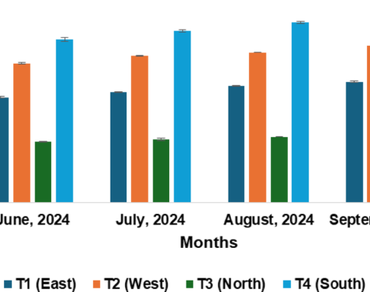
Sunburn is a major heat-induced physiological disorder in citrus, particularly under the hot, arid conditions of southwestern Punjab. This study evaluated the influence of canopy orientation on sunburn incidence, fruit temperature and peel anatomical alterations in Kinnow and Daisy mandarins. Given that sunburn directly affects external fruit appearance and marketable quality, the objective was to determine how directional exposure alters fruit surface heating and the resulting severity of peel damage. Sunburn incidence was assessed across four canopy directions (east, west, north, south) from June to September 2024. South-facing fruits exhibited the highest sunburn incidence in both cultivars (≈ 41–47% in Kinnow; 46–49% in Daisy), corresponding with elevated fruit temperatures (≈ 44–45 °C), whereas north-facing fruits showed the lowest incidence (≈ 15–20%) due to comparatively cooler surfaces. Despite a gradual decline in ambient temperature between June and September, exposed fruits maintained higher temperatures than the maximum air temperature because of greater radiant heat load. Microscopy revealed progressive anatomical deterioration with increasing injury severity, including deformation of oil glands and disruption of epidermal and hypodermal layers. Thus, the study demonstrated that canopy orientation strongly influences fruit microclimate and sunburn susceptibility. South and west orientations produced fruits with more pronounced surface damage and compromised visual quality. These findings emphasize the need for orientation-specific management strategies to reduce sunburn-related cosmetic losses and sustain fruit quality under warming climatic conditions.
References
Barber HN, Sharpe PJH (1971) Genetics and physiology of sunscald of fruits. J Agric Meteorol 8:175–191
Blanke MM, Lenz F (1989) Fruit photosynthesis. Plant Cell Environ 12:31–46. https://doi.org/10.1111/j.1365-3040.1989.tb01914.x
Brooks C, Fisher DF (1926) Some high-temperature effects in apples: contrasts in the two sides of an apple. J Agric Res 32:1–16
Chander S, Kumar K, Kaur M, Rattanpal HS, Arora PK (2025) Performance evaluation of different cultivars of mandarin. Indian J Agric Sci 95:962–967
El-Tanany MM, Kheder AMA, Abdallah HR (2019) Effect of some treatments on reducing sunburn in Balady mandarin. Middle East J Agric Res 8:889–897
Ferguson I, Volz R, Woolf A (1999) Preharvest factors affecting physiological disorders of fruit. Postharvest Biol Technol 15:255–262. https://doi.org/10.1016/S0925-5214(98)00089-9
Fischer G, Orduz-Rodríguez JO, Amarante CVT (2022) Sunburn disorder in tropical and subtropical fruits. Rev Colomb Cienc Hortic 16:e15703. https://doi.org/10.17584/rcch.2022v16i1.15703
Ketchie DO, Ballard AL (1968) Environments which cause heat injury to ‘Valencia’ oranges. J Am Soc Hortic Sci 93:166–172
Kim M, Park Y, Yun SK, Kim SS, Joa J, Moon YE, Do GR (2022) Anatomical differences and physiological responses of sunburned satsuma mandarin. Plants 11:1801. https://doi.org/10.3390/plants11141801
Lal N, Sahu N (2017) Management strategies of sunburn in fruit crops. Int J Curr Microbiol Appl Sci 6:1126–1138. https://doi.org/10.20546/ijcmas.2017.603.132
Minessy FA (1969) Citrus fruit temperature in relation to sunburn. In: Proceedings of the Conference on Tropical and Subtropical Fruits. Tropical Products Institute, London School of Pharmacy, Brunswick Square, London, pp 245–252
Mishra DS, Tripathi A, Nimbolkar PK (2016) Review on physiological disorders of tropical and subtropical fruits. Int J Agric Environ Biotechnol 9:925–935. https://doi.org/10.5958/2230-732X.2016.00118.2
Parkhe SR, Dahale MH, Paithankar DH, Nagre PK, Ingle YV (2022) Study of chemical substances on preventing sunburn injury of mandarin. Pharma Innov J 11:751–755
Rabinowitch HD, Ben-David B, Friedmann M (1986) Light is essential for sunscald induction in cucumber and pepper fruits. Sci Hortic 29:21–29
Racskó J, Thurzo S, Szabó Z, Nyéki J (2005a) Effect of sunburn on Malus domestica (Borkh.) apples. Gesunde Pflanzen 57:47–52. https://doi.org/10.1007/s10343-005-0070-7
Racskó J, Nagy J, Szabó Z, Major M, Nyéki J (2005b) Impact of location, row direction, plant density and rootstock on sunburn damage of apple cultivars. Int J Hortic Sci 11:19–30
Racsko J, Schrader LE (2012) Sunburn of apple fruit: historical background and recent advances. Crit Rev Plant Sci 31:455–504. https://doi.org/10.1080/07352689.2012.696453
Rodriguez J, Anoruo A, Jifon J, Simpson C (2019) Physiological effects of exogenously applied reflectants and anti-transpirants on leaf temperature and fruit sunburn in citrus. Plants 8:549. https://doi.org/10.3390/plants8120549
Schrader LE, Zhang J, Duplaga WK (2001) Two types of sunburn in apple caused by high peel temperature. Plant Health Prog 2:3. https://doi.org/10.1094/PHP-2001-1004-01-RS
Schrader LE, Kahn CB, Felicetti DA, Sun J, Xu J, Zhang J (2008) Effects of high temperature and high solar irradiance on sunburn. Acta Hortic 903:1025–1039. https://doi.org/10.17660/ActaHortic.2011.903.138
Schrader LE, Zhang J, Sun J (2003) Environmental stresses that cause sunburn of apple. Acta Hortic 618:397–405. https://doi.org/10.17660/ActaHortic.2003.618.42
Singh K, Chander S, Jhanji S, Kumar K, Singh G (2026b) Kaolin and salicylic acid sprays alleviate sunburn incidence and improve fruit quality in Kinnow mandarin. N Z J Crop Hortic Sci. https://doi.org/10.1002/nzc2.70085
Singh K, Chander S, Jhanji S, Kumar K, Singh G (2026a) Kaolin and salicylic acid mitigate sunburn and enhance stress-responsive biochemical and fruit quality traits in Daisy Mandarin (Citrus reticulata Blanco) under arid conditions. J Plant Biochem Biotechnol. https://doi.org/10.1002/nzc2.70085
Tsai MS, Lee TC, Chang PT (2013) Comparison of paper bags, calcium carbonate, and shade nets for sunscald protection. HortTechnol 23:659–667
Wunsche JN, Lakso AN (2000) Apple tree physiology: implications for orchard and tree management. Compact Fruit Tree 33:82–88
Wunsche JN, Bowen J, Ferguson I, Woolf A, McGhie T (2004) Sunburn on apples: causes and control. Acta Hortic 636:631–636. https://doi.org/10.17660/ActaHortic.2004.636.78
Yasuhiko K, Tomoka S, Mari N (2020) Mechanism of sunscald occurrence and mitigation in citrus. Bull Yamaguchi Agric Gene Tec Ctr 11:61–73
Zaky AS, Mohamed HM, Badawy SM (2018) Effect of some materials on protecting Balady mandarin fruits from sunburn. J Plant Prod Mansoura Univ 9:1135–1141. https://doi.org/10.21608/jpp.2018.38679
Zhang JG, Chen SC, Li YL, Di B, Zhang JQ, Liu YF (2008) Effect of high temperature and excessive light stresses on PPO activity in apple peel. Acta Ecol Sinica 28:4645–4651
Verreynne S. and Merwe SV (2011) Sunburn reduction on Miho Wase Satsuma mandarin. South Africa Fruit Journal. 10 (2) : 52-55
Sheoran OP, Tonk DS, Kaushik LS, Hasija RC, Pannu RS (1998) Statistical software package for agricultural research workers. In: Recent advances in information theory, statistics & computer applications. Department of Mathematics Statistics, CCS HAU, Hisar. 139–143
Author Information
PAU- Dr JC Bakhshi Regional Research Station, Abohar, India