Vegetos

(An International Journal of Plant Research & Biotechnology)
(eISSN: 2229-4473)
Struchium sparganophorum leaf extracts and essential oil: a promising source of dermatoprotective bioactive compounds
*Article not assigned to an issue yet
Nguyen Huong Thu Thi, Nguyen Phung Kim, Tran Hao Thanh, Vo Nhan Thanh, Nguyen Anh Hoang Tran, Ly Trieu Hai
Research Articles | Published: 26 September, 2026
First Page: 0
Last Page: 0
Views: 99
Keywords: n Struchium sparganophorumn , Essential oil composition, Antibacterial activity, Antidermatophytic activity, Collagenase inhibition, Tyrosinase inhibition
Abstract
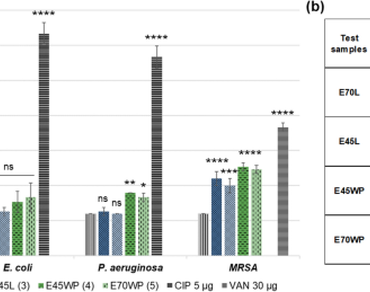
Struchium sparganophorum (L.) Kuntze is traditionally used for skin-related conditions, but its antimicrobial and antidermatophytic activities, collagenase and tyrosinase inhibition, and leaf essential oil composition remain insufficiently characterized. This study evaluated the in vitro bioactivities of ethanolic leaf and whole-plant extracts and hydrodistilled leaf essential oil of S. sparganophorum. Extracts were prepared by percolation with 45% or 70% ethanol. Antibacterial activity of the extracts was assessed by agar-well diffusion and agar dilution minimum inhibitory concentration (MIC) testing, whereas antifungal activity was performed by agar-well diffusion. The leaf essential oil was characterized by gas chromatography–mass spectrometry (GC–MS) and evaluated for antibacterial MIC, as well as collagenase and tyrosinase inhibition. GC–MS tentatively identified 15 oil constituents, dominated by heneicosane (40.71%), docosane (20.44%), and n-hexadecanoic acid (15.94%). Ethanolic extracts generally produced larger inhibition zones against Gram-positive bacteria than Gram-negative bacteria, with MIC values mostly at 15 mg/mL, except for the 70% ethanol whole-plant extract against Escherichia coli (30 mg/mL). The leaf essential oil showed MIC values ranging from 0.375 to 1.50 mg/mL. The extracts showed no inhibition beyond the 8-mm well diameter against Candida albicans but produced distinct inhibition zones against dermatophytes, with the 45% ethanol leaf extract showing a mean ZOI of up to 32.33 mm. Furthermore, the 70% ethanol leaf extract showed the lowest calculated IC50 values among all tested extracts for collagenase (565.54 µg/mL) and tyrosinase (19.58 µg/mL) inhibition. These findings provide preliminary in vitro evidence supporting further investigation of S. sparganophorum as a plant-derived source for cosmeceutical research.
References
Ayinde B, Agbakwuru U (2010) Cytotoxic and growth inhibitory effects of the methanol extract Struchium sparganophora Ktze (Asteraceae) leaves. Pharmacogn Mag 6:293–297. https://doi.org/10.4103/0973-1296.71795
Balouiri M, Sadiki M, Ibnsouda SK (2016) Methods for in vitro evaluating antimicrobial activity: a review. J Pharm Anal 6:71–79. https://doi.org/10.1016/j.jpha.2015.11.005
Bassolé IHN, Juliani HR (2012) Essential oils in combination and their antimicrobial properties. Molecules 17:3989–4006. https://doi.org/10.3390/molecules17043989
Chauhan P, Meena D, Errichetti E (2023) Dermoscopy of bacterial, viral, and fungal skin infections: a systematic review of the literature. Dermatol Ther 13:51–76. https://doi.org/10.1007/s13555-022-00855-2
Chen H, Gu Z, Yang L, Yang R, Ji Y, Zeng Q, Xiao F, Huang P (2021) Optimization extraction of rosemary essential oils using hydrodistillation with extraction kinetics analysis. Food Sci Nutr 9:6069–6077. https://doi.org/10.1002/fsn3.2549
Clinical and Laboratory Standards Institute (CLSI) (2018) Methods for dilution antimicrobial susceptibility tests for bacteria that grow aerobically (M07), 11th edn. CLSI, Wayne, PA
Davis WW, Stout TR (1971) Disc plate method of microbiological antibiotic assay. I. Factors influencing variability and error. Appl Microbiol 22:659–665. https://doi.org/10.1128/am.22.4.659-665.1971
Kasim LS, Olaleye KO, Fagbohun AB, Ibitoye SF, Adejumo OE (2014) Chemical composition and antibacterial activity of essential oils from Struchium sparganophora Linn. Ktze Asteraceae Adv Biol Chem 4:246–252. https://doi.org/10.4236/abc.2014.44030
Luger T, Amagai M, Dreno B, Dagnelie MA, Liao W, Kabashima K, Schikowski T, Proksch E, Elias PM, Simon M, Simpson E, Grinich E, Schmuth M (2021) Atopic dermatitis: role of the skin barrier, environment, microbiome, and therapeutic agents. J Dermatol Sci 102:142–157. https://doi.org/10.1016/j.jdermsci.2021.04.007
Ministry of Health, Vietnam (2018) Vietnamese Pharmacopoeia, 5th edn. Medical Publishing House, Hanoi
Mukherjee PK, Biswas R, Sharma A, Banerjee S, Biswas S, Katiyar CK (2018) Validation of medicinal herbs for anti-tyrosinase potential. J Herb Med 14:1–16. https://doi.org/10.1016/j.hermed.2018.09.002
Nguyen TTQ, Pho TPL, Nguyen DN, Tran TD, Nguyen TTH (2025) Polyphenol and flavonoid contents and the antioxidant activity of extracts from Struchium sparganophorum (L.) Kuntze (Asteraceae). Hong Bang International University J Sci 05:200–210. (in Vietnamese). https://doi.org/10.59294/hiujs.khsk.2025.021
Nikaido H (2003) Molecular basis of bacterial outer membrane permeability revisited. Microbiol Mol Biol Rev 67:593–656. https://doi.org/10.1128/mmbr.67.4.593-656.2003
Oboh G (2006) Nutritive value, antioxidant and antimicrobial properties of Struchium sparganophora leaves. J Med Food 9:276–280. https://doi.org/10.1089/jmf.2006.9.276
Ouchari L, Boukeskasse A, Bouizgarne B, Ouhdouch Y (2019) Antimicrobial potential of actinomycetes isolated from the unexplored hot Merzouga desert and their taxonomic diversity. Biol Open 8:bio035410. https://doi.org/10.1242/bio.035410
Ríos JL, Recio MC, Villar A (1988) Screening methods for natural products with antimicrobial activity: a review of the literature. J Ethnopharmacol 23:127–149. https://doi.org/10.1016/0378-8741(88)90001-3
Sin BY, Kim HP (2005) Inhibition of collagenase by naturally-occurring flavonoids. Arch Pharm Res 28:1152–1155. https://doi.org/10.1007/bf02972978
Wittenauer J, Mäckle S, Sußmann D, Schweiggert-Weisz U, Carle R (2015) Inhibitory effects of polyphenols from grape pomace extract on collagenase and elastase activity. Fitoterapia 101:179–187. https://doi.org/10.1016/j.fitote.2015.01.005
Author Information
Faculty of Pharmacy, Hong Bang International University, Ho Chi Minh, Vietnam