Vegetos

(An International Journal of Plant Research & Biotechnology)
(eISSN: 2229-4473)
Seed priming with H₂O₂ enhanced germination, growth, and water relations of wheat under salt stress
*Article not assigned to an issue yet
Orthy Mariam Akter, Baque Md. Abdullahil, Shawon Tanzena Akter, Masud Abdul Awal Chowdhury
Research Article | Published: 08 January, 2026
First Page: 0
Last Page: 0
Views: 786
Keywords: Wheat, Salt stress, Hydrogen peroxide, Seed priming, Stress memory, Germination traits
Abstract
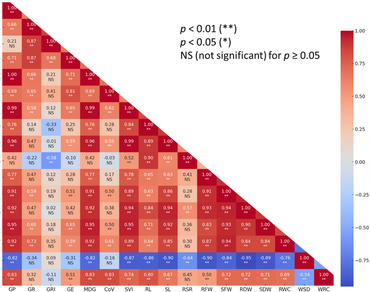
Global wheat production has decreased significantly due to salt stress, particularly affecting germination and early seedling development. This study examined the effectiveness of hydrogen peroxide (H₂O₂) as a seed-priming agent in mitigating the adverse effects of salt stress on wheat germination and early seedling growth. Seeds of the wheat genotype ESWYT 5 was primed with 50 mM H₂O₂ for 9 h and subsequently subjected to three salinity treatments (50, 100, and 150 mM NaCl) for 7 days. Results revealed that salt stress substantially inhibited both germination and seedling development, with the most pronounced reductions occurring at 150 mM NaCl. Germination was reduced by 15%, while root and shoot fresh weights (FW) declined by 39% and 37%, respectively. Similarly, root and shoot dry weights (DW) decreased by 42% and 25%. The seedling vigor index (SVI) dropped by 30%. In addition, both relative water content (RWC) and water retention capacity (WRC) declined significantly, with reductions of 11% and 28%, respectively. However, H₂O₂ seed priming (50 mM for 9 h) significantly improved germination and seedling performance in wheat under salinity. At 100 mM NaCl, primed seeds exhibited a 3% higher germination rate and an 8% increase in shoot length compared to non-primed seeds. The seedling vigor index improved by 5%, while the relative water content rose by 2% under 50 mM NaCl, indicating enhanced water retention capacity. Among the tested salinity levels, wheat seedlings primed with 50 mM H₂O₂ demonstrated the best performance under 50 mM NaCl stress. These quantitative gains affirm the physiological benefits of optimized H₂O₂ priming in mitigating salt stress during early wheat growth.
References
Abdel Latef AAH, Kordrostami M, Zakir A, Zaki H, Saleh OM (2019) Eustress with H2O2 facilitates plant growth by improving tolerance to salt stress in two wheat cultivars. Plants 8(9):303. https://doi.org/10.3390/plants8090303
Abdel Latef AAH, Abu Alhmad MF, Kordrostami M, Abo-Baker ABAE, Zakir A (2020) Inoculation with Azospirillum lipoferum or Azotobacter chroococcum reinforces maize growth by improving physiological activities under saline conditions. J Plant Growth Regul 39(3):1293–1306. https://doi.org/10.1007/s00344-020-10065-9
Alencar NL, Gadelha CG, Gallão MI, Dolder MA, Prisco JT, Gomes-Filho E (2015) Ultrastructural and biochemical changes induced by salt stress in Jatropha curcas seeds during germination and seedling development. Funct Plant Biol 42(9):865–874. https://doi.org/10.1071/FP15019
Ashfaque F, Khan MIR, Khan NA (2013) Exogenously applied H2O2 promotes proline accumulation, water relations, photosynthetic efficiency and growth of wheat (Triticum aestivum L.) under salt stress. Annu Res Rev Biol 4(1):105–120. https://doi.org/10.9734/ARRB/2014/5629
Ashraf MFMR, Foolad MR (2007) Roles of glycine betaine and proline in improving plant abiotic stress resistance. Environ Exp Bot 59(2):206–216. https://doi.org/10.1016/j.envexpbot.2005.12.006
Ashraf M, Rauf H (2001) Inducing salt tolerance in maize (Zea mays L.) through seed priming with chloride salts: growth and ion transport at early growth stages. Acta Physiol Plant 23:407–414. https://doi.org/10.1007/s11738-001-0050-9
Balasubramaniam T, Shen G, Esmaeili N, Zhang H (2023) Plants’ response mechanisms to salinity stress. Plants 12(12):2253. https://doi.org/10.3390/plants12122253
Capitulino JD, Lima GSD, Azevedo CAVD, Silva AARD, Arruda TFDL, Soares LADA, Gheyi HR, Dantas Fernandes P, Sobral de Farias MS, Silva FDAD, Dias MDS (2023) Influence of foliar application of hydrogen peroxide on gas exchange, photochemical efficiency, and growth of soursop under salt stress. Plants 12(3):599. https://doi.org/10.3390/plants12030599
Choudhary R, Rajput VD, Ghodake G, Ahmad F, Meena M, Rehman RU, Prasad R, Sharma RK, Singh R, Seth CS (2024) Comprehensive journey from past to present to future about seed priming with hydrogen peroxide and hydrogen sulfide concerning drought, temperature, UV and ozone stresses—a review. Plant Soil 500(1):351–373. https://doi.org/10.1007/s11104-024-06499-9
Chu C, Poore RC, Bolton MD, Fugate KK (2022) Mechanism of sugarbeet seed germination enhanced by hydrogen peroxide. Front Plant Sci 13:888519. https://doi.org/10.3389/fpls.2022.888519
Dong YJ, Wang WW, Hu GQ, Chen WF, Zhuge YP, Wang ZL, He MR (2017) Role of exogenous 24-epibrassinolide in enhancing the salt tolerance of wheat seedlings. J Soil Sci Plant Nutr 17(3):554–569. https://doi.org/10.4067/S0718-95162017000300001
Farooq M, Basra SMA, Rehman H, Saleem BA (2008) Seed priming enhances the performance of late sown wheat (Triticum aestivum L.) by improving chilling tolerance. J Agron Crop Sci 194(1):55–60. https://doi.org/10.1111/j.1439-037X.2007.00287.x
Gondim FA, Miranda RS, Gomes-Filho E, Prisco JT (2013) Enhanced salt tolerance in maize plants induced by H2O2 leaf spraying is associated with improved gas exchange rather than with non-enzymatic antioxidant system. Theor Exp Plant Physiol 25(4):251–260.
Habib N, Ali Q, Ali S, Javed MT, Zulqurnain Haider M, Perveen R, Shahid MR, Rizwan M, Abdel-Daim MM, Elkelish A, Bin-Jumah M (2020) Use of nitric oxide and hydrogen peroxide for better yield of wheat (Triticum aestivum L.) under water deficit conditions: growth, osmoregulation, and antioxidative defense mechanism. Plants 9(2):285. https://doi.org/10.3390/plants9020285
Hasanuzzaman M, Nahar K, Fujita M (2013) Plant response to salt stress and role of exogenous protectants to mitigate salt-induced damages. In: Ahmad P, Azooz M, Prasad M (eds) Ecophysiology and Responses of Plants under Salt Stress. Springer, New York NY, pp 25–87. https://doi.org/10.1007/978-1-4614-4747-4_2
Hassan MU, Chattha MU, Khan I, Chattha MB, Barbanti L, Aamer M, Iqbal MM, Nawaz M, Mahmood A, Ali A, Aslam MT (2021) Heat stress in cultivated plants: nature, impact, mechanisms, and mitigation strategies—a review. Plant Biosyst 155(2):211–234. https://doi.org/10.1080/11263504.2020.1727987
Hemalatha G, Renugadevi J, Eevera T (2017) Studies on seed priming with hydrogen peroxide for mitigating salt stress in rice. Int J Curr Microbiol App Sci 6(6):691–695. https://doi.org/10.20546/ijcmas.2017.606.081
Hmissi M, Chaieb M, Krouma A (2023) Differences in the physiological indicators of seed germination and seedling establishment of durum wheat (Triticum durum Desf.) cultivars subjected to salinity stress. Agronomy 13(7):1718. https://doi.org/10.3390/agronomy13071718
Hossain MS (2019) Present scenario of global salt affected soils, its management and importance of salinity research. Int Res J Biol Sci 1(1):1–3 .
Hossain MA, Khatun M, Hosen M, Sayed ZI, Islam MR, Chowdhury MK, Iqbal MA, Al-Ashkar I, Erden Z, Toprak CC, El Sabagh A (2024) Citric acid alleviated salt stress by modulating photosynthetic pigments, plant water status, yield and nutritional quality of black gram [Vigna mungo (L.) Hepper]. Legume Res Int J. https://doi.org/10.18805/LRF-820
Hualpa-Ramirez E, Carrasco-Lozano EC, Madrid-Espinoza J, Tejos R, Ruiz-Lara S, Stange C, Norambuena L (2024) Stress salinity in plants: new strategies to cope with in the foreseeable scenario. Plant Physiol Biochem 208:108507. https://doi.org/10.1016/j.plaphy.2024.108507
Isayenkov SV, Maathuis FJM (2019) Plant salinity stress: many unanswered questions remain. Front Plant Sci 10:80. https://doi.org/10.3389/fpls.2019.00080
Khan MSA, Karim MA, Al-Mahmud A, Parveen S, Bazzaz MM, Hossain MA (2015) Plant water relations and proline accumulations in soybean under salt and water stress environment. J Plant Sci 3:272–278. https://doi.org/10.11648/j.jps.20150305.15
Li Z, Xu J, Gao Y, Wang C, Guo G, Luo Y, Huang Y, Hu W, Sheteiwy MS, Guan Y, Hu J (2017) The synergistic priming effect of exogenous salicylic acid and H2O2 on chilling tolerance enhancement during maize (Zea mays L.) seed germination. Front Plant Sci 8:1153. https://doi.org/10.3389/fpls.2017.01153
Machado RMA, Serralheiro RP (2017) Soil salinity: effect on vegetable crop growth. Management practices to prevent and mitigate soil salinization. Horticulturae 3:30. https://doi.org/10.3390/horticulturae3020030
Mohamed HE, Hemeida AE, Mohamed AG (2015) Role of hydrogen peroxide pretreatment on developing antioxidant capacity in the leaves of tomato plant (Lycopersicon esculentum) grown under saline stress. Int J Adv Res 3:878–879
Momeni MM, Kalantar M, Dehghani-Zahedani M (2023) H2O2 seed priming improves tolerance to salinity stress in durum wheat. Cereal Res Commun 51:391–401
Niu M, Xie J, Chen C, Cao H, Sun J, Kong Q, Shabala S, Shabala L, Huang Y, Bie Z (2018) An early ABA-induced stomatal closure, Na⁺ sequestration in leaf vein and K⁺ retention in mesophyll confer salt tissue tolerance in Cucurbita species. J Exp Bot 69:4945–4960. https://doi.org/10.1093/jxb/ery251
Oner F, Kırlı A (2018) Effects of salt stress on germination and seedling growth of different bread wheat (Triticum aestivum L.) cultivars. Akad Ziraat Derg 7:191–196. https://doi.org/10.29278/azd.476365
Parvin K, Hasanuzzaman M, Bhuyan MB, Nahar K, Mohsin SM, Fujita M (2019) Comparative physiological and biochemical changes in tomato (Solanum lycopersicum L.) under salt stress and recovery: role of antioxidant defense and glyoxalase systems. Antioxidants 8:350. https://doi.org/10.3390/antiox8090350
Ranal MA, Santana DGD (2006) How and why to measure the germination process? Braz J Bot 29:1–11. https://doi.org/10.1590/S0100-84042006000100002
Rasel M, Tahjib-Ul-Arif M, Hossain MA, Hassan L, Farzana S, Brestic M (2021) Screening of salt-tolerant rice landraces by seedling stage phenotyping and dissecting biochemical determinants of tolerance mechanism. J Plant Growth Regul 40:1853–1868. https://doi.org/10.1007/s00344-020-10235-9
Rhaman MS, Kibria MG, Hossain M, Hoque MA (2016) Effects of organic manure and bio-slurries with chemical fertilizers on growth and yield of rice (cv. BRRI dhan28). Int J Exp Agric 6:36–42
Rhaman MS, Rauf F, Tania SS, Karim MM, Sagar A, Robin AHK, Murata Y, Latef AAHA (2021) Seed priming and exogenous application of salicylic acid enhance growth and productivity of okra (Abelmoschus esculentus L.) by regulating photosynthetic attributes. J Exp Biol Agric Sci 9:759–769. https://doi.org/10.18006/2021.9(6).759.769
Rhaman MS, Rauf F, Tania SS, Bayazid N, Tahjib-ul-Arif M, Robin AHK, Hoque MA, Yang X, Murata Y, Brestic M (2024) Proline and glycine betaine: a dynamic duo for enhancing salt stress resilience in maize by regulating growth, stomatal size, and oxidative stress responses. Plant Stress 14:100563. https://doi.org/10.1016/j.stress.2024.100563
Rybka K, Janaszek-Mańkowska M, Siedlarz P, Mańkowski D (2019) Machine learning in determination of water saturation deficit in wheat leaves on basis of Chl a fluorescence parameters. Photosynthetica. https://doi.org/10.32615/ps.2019.017
Sangakkara UR, Hartwig UA, Nösberger J (1996) Response of root branching and shoot water potentials of french beans (Phaseolus vulgaris L.) to soil moisture and fertilizer potassium. J Agron Crop Sci 177(3):165–173. https://doi.org/10.1111/j.1439-037X.1996.tb00234.x
Savvides A, Ali S, Tester M, Fotopoulos V (2016) Chemical priming of plants against multiple abiotic stresses: mission possible? Trends Plant Sci 21(4):329–340. https://doi.org/10.1016/j.tplants.2015.11.003
Seleiman MF, Aslam MT, Alhammad BA, Hassan MU, Maqbool R, Chattha MU, Khan I, Gitari HI, Uslu OS, Roy R, Battaglia ML (2022) Salinity stress in wheat: effects, mechanisms and management strategies. Phyton. https://doi.org/10.32604/phyton.2022.017365
Shelar PV, Mankar GD, Sontakke OP, Wayase UR, Bhosale KS, Nikalje GC, Ahire ML, Nikam TD, Barmukh RB (2024) A review of the physio-biochemical and molecular mechanisms of salt tolerance in crop. Curr Agric Res J. https://doi.org/10.12944/CARJ.12.2.05
Shiade SRG, Boelt B (2020) Seed germination and seedling growth parameters in nine tall fescue varieties under salinity stress. Acta Agric Scand Sect B Soil Plant Sci 70(6):485–494. https://doi.org/10.1080/09064710.2020.1779338
Sultan MT, Mahmud U, Khan MZ (2023) Addressing soil salinity for sustainable agriculture and food security: innovations and challenges in coastal regions of Bangladesh. Future Foods 8:100260. https://doi.org/10.1016/j.fufo.2023.100260
Tahjib-Ul-Arif M, Afrin S, Polash MAS, Akter T, Ray SR, Hossain MT, Hossain MA (2019) Role of exogenous signaling molecules in alleviating salt-induced oxidative stress in rice (Oryza sativa L.): a comparative study. Acta Physiol Plant 41:1–14. https://doi.org/10.1007/s11738-019-2861-6
Talska R, Machalová J, Smýkal P, Hron K (2020) A comparison of seed germination coefficients using functional regression. Appl Plant Sci 8(8):e11366. https://doi.org/10.1002/aps3.11366
Tania SS, Rhaman MS, Rauf F, Rahaman MM, Kabir MH, Hoque MA, Murata Y (2022) Alleviation of salt-inhibited germination and seedling growth of kidney bean by seed priming and exogenous application of salicylic acid (SA) and hydrogen peroxide (H2O2). Seeds 1(2):87–98. https://doi.org/10.3390/seeds1020008
Tester M, Davenport R (2003) Na⁺ tolerance and Na⁺ transport in higher plants. Ann Bot 91(5):503–527. https://doi.org/10.1093/aob/mcg058
Turan MA, Elkarim AHA, Taban N, Taban S (2009) Effect of salt stress on growth, stomatal resistance, proline and chlorophyll concentrations on maize plant. Afr J Agric Res 4(9):893–897.
Veerana M, Mumtaz S, Rana JN, Javed R, Panngom K, Ahmed B, Akter K, Choi EH (2024) Recent advances in non-thermal plasma for seed germination, plant growth, and secondary metabolite synthesis: a promising frontier for sustainable agriculture. Plasma Chem Plasma Process 44(6):2263–2302. https://doi.org/10.1007/s11090-024-10510-7
Wang JT, Li QK (2012) Study of water-salt production function based on saline water irrigation. Adv Mater Res 518:4350–4353. https://doi.org/10.4028/www.scientific.net/AMR.518-523.4350
Wang Y, Zhang J, Li JL, Ma XR (2014) Exogenous hydrogen peroxide enhanced the thermotolerance of Festuca arundinacea and Lolium perenne by increasing the antioxidative capacity. Acta Physiol Plant 36:2915–2924. https://doi.org/10.1007/s11738-014-1661-2
Xue F, Liu W, Cao H, Song L, Ji S, Tong L, Ding R (2021) Stomatal conductance of tomato leaves is regulated by both abscisic acid and leaf water potential under combined water and salt stress. Physiol Plant 172(4):2070–2078. https://doi.org/10.1111/ppl.13441
Yao X, Zhou M, Ruan J, Peng Y, Ma C, Wu W, Gao A, Weng W, Cheng J (2022) Physiological and biochemical regulation mechanism of exogenous hydrogen peroxide in alleviating NaCl stress toxicity in tartary buckwheat (Fagopyrum tataricum (L.) Gaertn). Int J Mol Sci 23(18):10698. https://doi.org/10.3390/ijms231810698
Zahra N, Mahmood S, Raza ZA (2018) Salinity stress on various physiological and biochemical attributes of two distinct maize (Zea mays L.) genotypes. J Plant Nutr 41(11):1368–1380. https://doi.org/10.1080/01904167.2018.1452939
Author Information
Department of Agronomy, Sher-E-Bangla Agricultural University, Dhaka, Bangladesh