Vegetos

(An International Journal of Plant Research & Biotechnology)
(eISSN: 2229-4473)
Neptunia oleracea Lour. (Fabaceae): a literature review on nutritional benefits, ethnomedicine, phytochemistry, pharmacology, and toxicology
*Article not assigned to an issue yet
Van Chen Tran, Thinh Hua Thanh Truong, Van Truong Sanh Nguyen, Khoa Tran Viet Dang, Lam Duong Nguyen Xuan, Nguyen Tien V. T., Boonma Thawatphong
Review Article | Published: 19 May, 2026
First Page: 0
Last Page: 0
Views: 557
Keywords: n Neptunia oleracean , Nutritional value, Pharmacology, Phytochemistry, Traditional use
Abstract
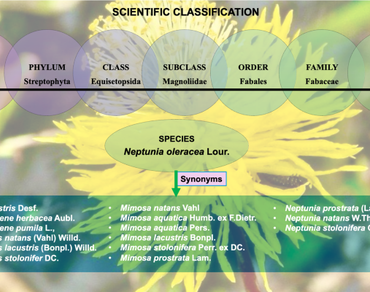
Neptunia oleracea Lour., commonly known as “Yellow Pan Weed, Water Mimosa or Water Sensitive Plant”, is a wild aquatic plant of the genus Neptunia in the family Fabaceae, and its parts can be used as food and in medicine. With further exploration, its applications are found in various fields, including food, agriculture, and medicinal herbs. This review summarizes traditional knowledge by integrating it with scientific evidence related to N. oleracea’s phytochemical compounds, pharmacological activities, and therapeutic potential. This narrative review analyzed 50 documents from databases, including Web of Science, Scopus, Google Scholar, ScienceDirect, SpringerLink, PubMed, and other online databases (1790–2025), focusing on articles and textbooks on N. oleracea’s botany, nutritional benefits, traditional uses, phytochemistry, and pharmacological properties. 54 metabolites, including pheophorbides, phenolics, flavonoids, and other compounds, were found in N. oleracea. The extracts from N. oleracea parts and its isolated compounds have been shown to possess various biological properties, including antioxidant, antimicrobial, anti‐inflammatory, analgesic, anticancer, antiulcer, astringent, anti-5α-reductase, and anti-diabetic activities. These pharmacological properties are closely associated with the presence of phenolic compounds, particularly flavonoids. Various parts of N. oleracea contain nutritional components, minerals, and vitamins. Although some evidence supports the link between traditional uses and modern pharmacology, significant knowledge gaps still hinder its integration into evidence-based clinical applications. In the future, prioritizing large-scale clinical studies and developing combination formulations will further elucidate and expand the therapeutic potential of N. oleracea.
References
Abulude FO (2005) Nutritional evaluation of aquatic weeds in Nigeria. Elec J Env Agric Food Chem 4:835–840
Bean AR (2022) A revision of Neptunia Lour. (Leguminosae: Subfamily Caesalpinioideae, Mimosoid clade) in Australia and Malesia. Austrobaileya 12:59–106. https://doi.org/10.5962/p.366317
Bhoomannavar VS, Patil VP, Hugar S, Nanjappaiah HM, Kalyane N (2011) Anti-ulcer activity of Neptunia oleracea Lour. Pharmacol Online 3:1015–1020
Bhumireddy A, Nellore K, Alapati KS (2022) Anticancer activity of Neptunia oleracea methanolic extracts. Nat Prod Res 36:1053–1057. https://doi.org/10.1080/14786419.2020.1844693
Bhunia D, Mondal AK (2012) Systematic analysis (morphology, anatomy, and palynology) of an aquatic medicinal plant water mimosa (Neptunia oleracea Lour.) in Eastern India. Int J Life Sci Biotechnol Pharma Res 1:290–319
Chakraverty R, Aon P, Debnath T, Deb PK, Chakraborty P (2019) Elucidation of the antioxidant and antimicrobial activity of extracts of leaves of Neptunia prostrata Linn. Int J Pharm Phytopharm Res 9:76–80
D’Souza MA (1985) A book on tribal medicine. Publication Society for Promotion of Waste Land Development, New Delhi
Das HB, Majumdar K, Datta BK, Ray D (2009) Ethnobotanical uses of some plants by Tripuri and Reang tribes of Tripura. Nat Prod Radiance 8:172–180
Deb D, Datta BK, Debbarama J, Deb S (2016) Ethno-medicinal plants used for herbal jaundice medication by the indigenous community of Tripura, India. Biodiversitas 17:256–259. https://doi.org/10.13057/biodiv/d170137
Deb PK, Das S, Bhaumik KN, Ghosh R, Ghosh TK, Bhakta T (2013) Pharmacognostic and preliminary phytochemical investigations of Neptunia prostrata L. J Pharmacogn Phytochem 2:5–11
eFlora of India (FOI) (2025) Neptunia oleracea Lour. Database of Plants of Indian Subcontinent. Available via https://efloraofindia.com/2011/03/16/neptunia-oleracea/. Accessed 24 March 2025.
Flora Fauna Web (FFW) (2025) Neptunia oleracea Lour.. NParks Flora & Fauna Web. Available via https://www.nparks.gov.sg/florafaunaweb/flora/4/8/4844. Accessed 24 March 2025.
Ghosh R, Jajo H, Acharya PC (2017) An overview of Neptunia prostrata: a source of herbal medicine of ethnopharmacological importance. Glob J Pharmaceu Sci 2(1):555577. https://doi.org/10.19080/GJPPS.2017.02.555577
Halliwell B, Gutteridge JMC (2015) Free radicals in biology and medicine, 5th ed. Oxford University Press, New York, NY, USA
Igoli JO, Ogaji OG, Tor-Anyiin TA, Igoli NP (2005) Traditional medicine practice amongst the Igede people of Nigeria. Part II. Afr J Tradit Complement Altern Med 2:134–152
Irawan D, Wijaya CH, Limin SH, Hashimoto Y, Osaki M, Kulu IP (2006) Ethnobotanical study and nutrient potency of local traditional vegetables in Central Kalimantan. Tropics 15:441–448. https://doi.org/10.3759/tropics.15.441
Ita EO (1994) Aquatic plants and wetland wildlife resources of Nigeria. CIFA Occasional Paper. Rome, FAO 21:52
Jansen PCM, Westphal E, Siemonsma JS, Kasem Piluek (Eds.) (1993) Plant Resources of South-East Asia. Vegetables Pudoc 8:217–218
Jones MH, Csurhes S (2008) Pest Plant Risk Assessment: Water Mimosa Neptunia oleracea dead and awake Neptunia plena. Biosecurity Queensland Department of Primary Industries and Fisheries. Brisbane: Australia (2008). Available via https://www.daf.qld.gov.au/__data/assets/pdf_file/0019/62452/IPA-Water-Mimosa-Risk-Assessment.pdf
Kamaruzzaman SS, Ku CKAHC, Rahman SA, Mohamed IK, Eshak Z, Mahadi M (2023) Proximate nutritional analysis, phytochemical screening and antioxidant properties of aqueous extract of Neptunia oleracea leaves. Malays Appl Biol 52:91–99. https://doi.org/10.55230/mabjournal.v52i6.2696
Kruk J, Aboul-Enein HY, Kładna A, Bowser JE (2019) Oxidative stress in biological systems and its relation with pathophysiological functions: the effect of physical activity on cellular redox homeostasis. Free Radic Res 53:497–521. https://doi.org/10.1080/10715762.2019.1612059
Kumar N, Chaiyasut C (2017) Health promotion potential of vegetables cultivated in northern Thailand: a preliminary screening of tannin and flavonoid contents, 5α-reductase inhibition, astringent activity, and antioxidant activities. J Evid Based Complementary Altern Med 22:573–579. https://doi.org/10.1177/2156587216686689
Kumar S, Narain S (2010) Herbal remedies of wetlands macrophytes in India. Int J Pharma Bio Sci 1:1–12
Lee SY, Abas F, Khatib A, Ismail IS, Shaari K, Zawawi N (2016) Metabolite profiling of Neptunia oleracea and correlation with antioxidant and α-glucosidase inhibitory activities using 1H NMR-based metabolomics. Phytochem Lett 16:23–33. https://doi.org/10.1016/j.phytol.2016.02.014
Lee SY, Ismail IS, Ang EL, Abas F (2019a) Antioxidant, α-glucosidase inhibitory activities, and HPLC quantitative analysis of phenolic compounds isolated from Neptunia oleracea Lour. Int Food Res J 26:679–688
Lee SY, Mediani A, Ashikin AN, Azliana ABS, Abas F (2014) Antioxidant and α-glucosidase inhibitory activities of the leaf and stem of selected traditional medicinal plants. Int Food Res J 21:165–172
Lee SY, Mediani A, Ismail IS, Maulidiani AF (2019b) Antioxidants and α-glucosidase inhibitors from Neptunia oleracea fractions using 1H NMR-based metabolomics approach and UHPLC-MS/MS analysis. BMC Complement Altern Med 19:1–15. https://doi.org/10.1186/s12906-018-2413-4
Lee SY, Mediani A, Maulidiani M, Khatib A, Ismail IS, Zawawi N, Abas F (2018) Comparison of partial least squares and random forests for evaluating the relationship between phenolics and bioactivities of Neptunia oleracea. J Sci Food Agric 98:240–252. https://doi.org/10.1002/jsfa.8462
Łuczaj Ł, Lamxay V, Tongchan K, Xayphakatsa K, Phimmakong K, Radavanh S, Kanyasone V, Pietras M, Karbarz M (2021) Wild food plants and fungi are sold in the markets of Luang Prabang, Lao PDR. J Ethnobiol Ethnomed 17:1–27. https://doi.org/10.1186/s13002-020-00423-y
Marchetti PM, Barth JH (2013) Clinical biochemistry of dihydrotestosterone. Ann Clin Biochem 50:95–107. https://doi.org/10.1258/acb.2012.012159
Mendonca BB, Batista RL, Domenice S, Costa EM, Arnhold IJ, Russell DW, Wilson JD (2016) Steroid 5α-reductase 2 deficiency. J Steroid Biochem Mol Biol 163:206–211. https://doi.org/10.1016/j.jsbmb.2016.05.020
Muhakka MM, Suwignyo RA, Budianta D (2020) Nutritional values of swamp grasses as feed for Pampangan Buffaloes in South Sumatra, Indonesia. Biodiversitas 21:953–961. https://doi.org/10.13057/biodiv/d210314
Nakamura Y, Murakami A, Koshimizu K, Ohigashi H (1996) Identification of pheophorbide a and its related compounds as possible anti-tumor promoters in the leaves of Neptunia oleracea. Biosci Biotechnol Biochem 60:1028–1030. https://doi.org/10.1271/bbb.60.1028
Nguyen TQ, Nguyen HNM, Ngo DH, Phan PH, Vo TS (2022) The suppressive activity of water mimosa extract on human gastric cancer cells. Appl Sci (Basel) 12:6817. https://doi.org/10.3390/app12136817
Ogle BM, Tuyet HT, Duyet HN, Xuan Dung NN (2003) Food, feed or medicine: the multiple functions of edible wild plants in Vietnam. Econ Bot 57(1):103–117. https://doi.org/10.1663/0013-0001(2003)057[0103:FFOMTM]2.0.CO;2
Ouedraogo GG, Somda GD, Ilboudo S, Ouedraogo N, Koudou J, Guissou PI (2019) Phytochemical screening and toxicological study of Neptunia oleracea Lour. (Mimosaceae) extracts are plants used in traditional medicine. J Pharm Res Int 31:1–8. https://doi.org/10.9734/JPRI/2019/v31i630362
Paisooksantivatana Y (1993) Neptunia oleracea Loureiro. In: Siemonsma JS, Piluek K (eds) Plant resources of South-East Asia: vegetables, vol 8. Pudoc Scientific Publishers, Netherlands, pp 217–218
Paul SB, Choudhury SN, Biplab De BD (2012) Structural elucidation of a bioactive compound from the leaves of Neptunia prostrate. Asian J Chem 24:1469–1472
Phaniendra A, Jestadi DB, Periyasamy L (2015) Free radicals: properties, sources, targets, and their implication in various diseases. Indian J Clin Biochem 30:11–26. https://doi.org/10.1007/s12291-014-0446-0
Plants of the World Online (POWO) (2025a) Neptunia Lour. Kew Science. Available via https://powo.science.kew.org/taxon/urn:lsid:ipni.org:names:30003917-2. Accessed 24 March 2025.
Plants of the World Online (POWO) (2025b) Neptunia oleracea Lour.. Kew Science. Available via https://powo.science.kew.org/taxon/urn:lsid:ipni.org:names:509607-1. Accessed 24 March 2025.
Radha KM, Puri S, Pundir A, Bangar SP, Changan S, Choudhary P, Parameswari E, Alhariri A, Samota KM, Damale RD, Singh S, Berwal MK, Dhumal S, Bhoite AG, Senapathy M, Sharma A, Bhushan B, Mekhemar M (2021) Evaluation of nutritional, phytochemical, and mineral composition of selected medicinal plants for therapeutic uses from cold desert of Western Himalaya. Plants 10:1429. https://doi.org/10.3390/plants10071429
Rattanasena P (2012) Antioxidant and antibacterial activities of vegetables and fruits commonly consumed in Thailand. Pak J Biol Sci 15:877–882. https://doi.org/10.3923/pjbs.2012.877.882
Sagolshemcha R, Singh R (2017) Traditional and biological uses of Neptunia oleracea Lour.: an overview. Int J Curr Res 9:51689–51694
Salguero CP (2003) A Thai herbal traditional recipes for health and harmony (Ed. Barton, L.). Findhorn Press, Scotland
Saupi N, Zakaria MH, Bujang JS, Arshad A (2015) The proximate compositions and mineral contents of Neptunia oleracea Loureiro, an aquatic plant from Malaysia. Emir J Food Agric 27:266–274. https://doi.org/10.9755/ejfa.v27i3.16876
Singh HB, Singh RS, Sandhu JS (2003) Herbal medicine of Manipur: A color encyclopaedia. Daya Publishing House, Delhi, p 27
Sonia Devi O, Nabachandra Singh T, Jairaj Singh L, Prasanta Singh T (2021) Biological importance and phytochemistry of Neptunia oleracea Lour: a mini review. Asian J Chem 33:2276–2280. https://doi.org/10.14233/ajchem.2021.23424
Tee ES, Lim CL (1991) Carotenoid composition and content of Malaysian vegetables and fruits by the AOAC and HPLC methods. Food Chem 41:309–339. https://doi.org/10.1016/0308-8146(91)90057-U
Thalang VN, Trakoontivakorn G, Nakahara K (2001) Determination of the antioxidant activity of some commonly consumed leafy vegetables in Thailand. JIRCAS 9:39–46
Uyub AM, Nwachukwu IN, Azlan AA, Fariza SS (2010) In-vitro antibacterial activity and cytotoxicity of selected medicinal plant extracts from Penang Island Malaysia on metronidazole-resistant-Helicobacter pylori and some pathogenic bacteria. Ethnobot Res Appl 8:095–106. https://doi.org/10.17348/era.8.0.95-106
Vardhana R (2008) Direct uses of medicinal plants and their identification. Sarup & Sons, India, p 242
Vijayashree SB, Suresh HM, Hemantkumar V, Hatapakki BC, Shivakumar SI, Hallikeri CS, Chandur VK (2006) Antiinflammatory activity of leaves of Neptunia oleracea. Adv Pharmacol Toxicol 3:21–24
Wahab A, Ismail SS, Abidin EZ, Praveena S (2014) Neptunia oleracea (water mimosa) as phytoremediation plant and the risk to human health: a review. Adv Environ Biol 8:187–194
World Plants (2025) Michael H (1994–2025): Synonymic Checklist and Distribution of the World Flora. Version 25.01, last update January 28th, 2025. Available via https://www.worldplants.de/world-plants-complete-list/complete-plant-list#plantUid-164131. Accessed 24 March 2025.
Zainuddin ID, Zulkifli MF, Ismail R, Kamal N, Mahadi M (2020) Metabolites profiling and antimicrobial activities in roots and leaves of Neptunia oleracea. Int J Pharm Res 12:1998–2006. https://doi.org/10.31838/ijpr/2020.12.03.278
Zakaria MH, Ramaiya SD, Bidin N, Syed NNF, Bujang JS (2023) Nutritional values of wild edible freshwater macrophytes. PeerJ 11:e15496. https://doi.org/10.7717/peerj.15496
Author Information
Faculty of Traditional Medicine, University of Medicine and Pharmacy at Ho Chi Minh City, Ho Chi Minh City, Vietnam