Vegetos

(An International Journal of Plant Research & Biotechnology)
(eISSN: 2229-4473)
From stress resistance to recovery: a new framework for breeding climate-resilient crops
*Article not assigned to an issue yet
Editorial | Published: 23 November, 2026
First Page: 0
Last Page: 0
Views: 196
Keywords: Adaptation, Drought, Crop breeding, Perennial crops, Genetic resources, Plant phenotyping
Abstract
What happens after the stress ends?
The main focus of plant breeders and farmers is on how the plants respond to a stress event. In the era of climate change, agriculture has been facing drought and heat stresses in an increasing frequency and intensity, although this trend varies between geographical regions. Rainfed farms are particularly fragile, considering that they rely only on natural water sources such as precipitation and soil-stored moisture, that cannot be adjusted to water needs. In this context, plant survival during a stress event is not adequate but we need to know to what extent, how fast and with which resource cost do plant growth and yield recover post-stress.
The process of recovery is a known mechanism in plant sciences, however, it has received less attention as compared to the plant functions during stress. In fact, a recent review study revealed that the phase of recovery was much understudied compared to the phase of drought, and less attention was paid to roots compared to shoots (Zheng et al. 2023). Through the same study, it was concluded that some traits that were considered critical for plant response to drought were not further tested for their role during recovery. However, in some crops, the final plant biomass receives stronger impact of the recovery phase compared to the stress phase (Zheng et al. 2023).
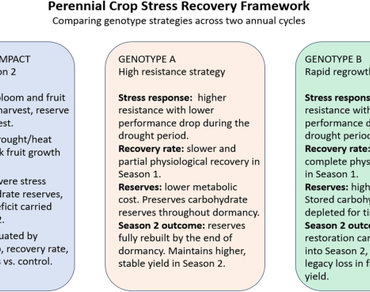
In the present editorial article, we discuss that recovery should have a more central position in plant breeding for climate change resilience, and should be determined together with stress resistance. There is accumulating evidence supporting the variable efficiency of genotypes during recovery while the heritability of that behavior as well as the distinction from tolerance have not been extensively elucidated. This gap is a great opportunity for future research.
References
Ahumada-Orellana L, Ortega-Farias S, Searles PS et al (2023) Leaf gas exchange, water status, and oil yield responses to rewatering after irrigation cut-off periods in a superintensive drip-irrigated olive (cv. Arbequina) orchard. Irrig Sci 41:557–570. https://doi.org/10.1007/s00271-022-00817-8
Ben Abdallah M, Methenni K, Taamalli W et al (2024) Post-stress recovery from drought and salinity in olive plants is an active process associated to physiological and metabolic changes. Acta Physiol Plant 46:120. https://doi.org/10.1007/s11738-024-03748-3
Bochmann H, Klein M, Henry A, Faßbender H, De Ocampo M, Kant J, Watt M (2025) Rice cycles between drought and well-watered-adapted phenotypes by changing lateral root formation. Ann Bot 136:1265–1277. https://doi.org/10.1093/aob/mcaf173
Choat B, Brodribb TJ, Brodersen CR, Duursma RA, López R, Medlyn BE (2018) Triggers of tree mortality under drought. Nature 558:531–539. https://doi.org/10.1038/s41586-018-0240-x
Cordovilla MdP, Rharrabti Y, El Yamani M (2025) Drought-Induced Changes in Morphology and Phenology of Olive Trees (Olea europaea L). Plants 14:3624. https://doi.org/10.3390/plants14233624
Deis L, Maza Deis S, Quiroga AM, Fort F (2026) Grapevine rootstocks for drought and heat tolerance: integrating physiological, hydraulic, and molecular mechanisms. Exp Agric 62:e14. https://doi.org/10.1017/S0014479726100349
Hassan MA, Dahu N, Hongning T, Qian Z, Yueming Y, Yiru L, Shimei W (2023) Drought stress in rice: morphophysiological and molecular responses and marker-assisted breeding. Front Plant Sci 14:1215371. https://doi.org/10.3389/fpls.2023.1215371
Hoang GT, Dinh LV, Nguyen TT, Ta NK, Gathignol F, Mai CD, Jouannic S, Tran KD, Khuat TH, Do VN, Lebrun M, Courtois B, Gantet P (2019) Genome-wide association study of a panel of Vietnamese rice landraces reveals new QTLs for tolerance to water deficit during the vegetative phase. Rice 12:4. https://doi.org/10.1186/s12284-018-0258-6
Kambona CM, Koua PA, Léon J, Ballvora A (2023) Stress memory and its regulation in plants experiencing recurrent drought conditions. Theor Appl Genet 136:26. https://doi.org/10.1007/s00122-023-04313-1
Litovchenko DA, Popova AA, Shestibratov KA, Krutovsky KV (2024) Climate Response and Radial Growth Dynamics of Pedunculate Oak (Quercus robur L.) Plus Trees and Their Half-Sib Progeny in Periods of Severe Droughts in the Forest-Steppe Zone of Eastern Europe. Plants 13:3213. https://doi.org/10.3390/plants13223213
Lloret F, Keeling EG, Sala A (2011) Components of tree resilience: effects of successive low-growth episodes in old ponderosa pine forests. Oikos 120:1909–1920. https://doi.org/10.1111/j.1600-0706.2011.19372.x
Luo LJ (2010) Breeding for water-saving and drought-resistance rice (WDR) in China. J Exp Bot 61:3509–3517. https://doi.org/10.1093/JXB/ERQ185
Marsh JI, Hu H, Gill M, Batley J, Edwards D (2021) Crop breeding for a changing climate: integrating phenomics and genomics with bioinformatics. Theor Appl Genet 134:1677–1690. https://doi.org/10.1007/s00122-021-03820-3
Özdemir B, Bektas H, Ülker M (2026) Deep rooting in bread wheat is more strongly associated with genotypes than drought stress: evidence from Van Lake Basin genotypes. Front Plant Sci 17:1887215. https://doi.org/10.3389/fpls.2026.1887215
Pascual LS, Segarra-Medina C, Gómez-Cadenas A, López-Climent MF, Vives-Peris V, Zandalinas SI (2022) Climate change-associated multifactorial stress combination: a present challenge for our ecosystems. J Plant Physiol 276:153764. https://doi.org/10.1016/j.jplph.2022.153764
Rivero RM, Mittler R, Blumwald E, Zandalinas SI (2022) Developing climate-resilient crops: improving plant tolerance to stress combination. Plant J 109:373–389. https://doi.org/10.1111/tpj.15483
Sánchez-Piñero M, Martín-Palomo MJ, Moriana A, Castro-Valdecantos P, Corell M (2026) Short-term physiological recovery and yield response of hedgerow olive orchards after prolonged water stress. Agric Water Manage 331:0378–3774. https://doi.org/10.1016/j.agwat.2026.110432
Schueler S, George J-P, Karanitsch-Ackerl S, Mayer K, Klumpp RT, Grabner M (2021) Evolvability of Drought Response in Four Native and Non-native Conifers: Opportunities for Forest and Genetic Resource Management in Europe. Front Plant Sci 12:648312. https://doi.org/10.3389/fpls.2021.648312
Varshney RK, Bohra A, Yu J, Graner A, Zhang Q, Sorrells ME (2021) Designing Future Crops: Genomics-Assisted Breeding Comes of Age. Trends in Plant Science, 26 – 6, 631–649. ISSN 1360–1385. https://doi.org/10.1016/j.tplants.2021.03.010
Vilonen L, Ross M, Smith MD (2022) What happens after drought ends: synthesizing terms and definitions. New Phytol 235:420–431. https://doi.org/10.1111/nph.18137
Yan W, Zheng S, Zhong Y, Shangguan Z (2017) Contrasting dynamics of leaf potential and gas exchange during progressive drought cycles and recovery in Amorpha fruticosa and Robinia pseudoacacia. Sci Rep 7:4470. https://doi.org/10.1038/s41598-017-04760-z
Zheng C, Bochmann H, Liu Z, Kant J, Schrey SD, Wojciechowski T, Postma JA (2023) Plant root plasticity during drought and recovery: what do we know and where to go? Front Plant Sci 14:1084355. https://doi.org/10.3389/fpls.2023.1084355
Zlobin IE (2024) Tree post-drought recovery: scenarios, regulatory mechanisms and ways to improve. Biol Rev 99:1595–1612. https://doi.org/10.1111/brv.13083
Author Information
Hellenic Agricultural Organization DIMITRA, Institute of Olive Tree, Subtropical Crops and Viticulture, Chania, Greece