Vegetos

(An International Journal of Plant Research & Biotechnology)
(eISSN: 2229-4473)
Buxus wallichiana Baill. an emerging forest stand of Garhwal Himalaya: an emphasis on its ecological traits and implications for its conservation
*Article not assigned to an issue yet
Research Article | Published: 20 January, 2026
First Page: 0
Last Page: 0
Views: 1148
Keywords: n B. wallichiana forest stand, Composition, Regeneration, Carbon sequestration, Disturbances, Conservation
Abstract
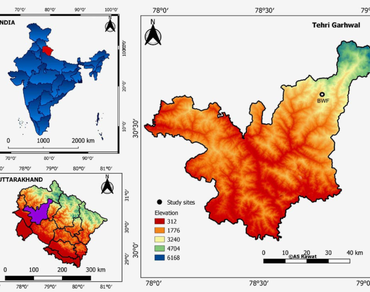
The Indian Himalayas harbor diverse forest ecosystems that play a critical role in biodiversity conservation, carbon sequestration, and sustaining local livelihoods. Among them, Buxus wallichiana Baill., a slow-growing and shade-tolerant species, has ecological and economic significance but is increasingly threatened by overexploitation and habitat degradation. A field survey conducted recently revealed a pure stand of B. wallichiana that had not been reported earlier from the Garhwal Himalaya, prompting an ecological assessment of its structure, regeneration, carbon stock, and disturbance dynamics. Vegetation data were collected by laying sampling plots of ten 0.1 ha. Tree, sapling, and seedling populations analyzed using standard methods. The results revealed a total of 11 tree species within the forest stand, with an overall density of 520 trees/ha and a total basal cover of 22.23 m2/ha. Buxus wallichiana contributed the highest density and basal cover (380 tree/ha and 14.65 m2/ha), followed by Quercus floribunda Lindl. ex A.Camus (20 tree/ha and 3.12 m2/ha). The community exhibited low overall diversity (H′ = 1.07) but strong dominance of B. wallichiana. Regeneration analysis indicated high recruitment, with 50% of species showing good regeneration and B. wallichiana contributing the maximum seedling (3750 seedling/ha) and sapling densities (1220 saplings/ha). The forest stored a substantial amount of biomass and carbon, with total carbon density estimated at 327.17 tC/ha, of which B. wallichiana and Quercus floribunda were the major contributors. Disturbance analysis revealed low to moderate anthropogenic pressures, including tree cutting, lopping, and livestock grazing. These findings highlight the ecological uniqueness of B. wallichiana-dominated forests in the Garhwal Himalaya, emphasizing their role in long-term carbon storage and the urgent need for targeted conservation and sustainable management strategies.
References
Ahmad M, Zafar M, Sultana S, Shaheen S, Khan MA (2015) Conservation assessment and distribution pattern of the threatened forest species in Pakistan: a case study of Buxus wallichiana Baill. Appl Ecol Environ Res 13(2):479–491. https://doi.org/10.15666/aeer/1302_479491
Anonymous (1997) The Wealth of India: A DICTIOnary of Indian Raw Materials and Industrial Products. Raw Materials, vol 2B. CSIR
Bagchi A, Singh RP (2011) District ground water brochure of Tehri Garhwal district, Uttarakhand, CGWB, Ministry of water resources Govt. of India, p 10. https://cgwb.gov.in/old_website/District_Profile/Uttarakhand/Tehri%20Garhwal.pdf
Bagri AS, Singh A, Rawat DS, Dhingra GK, Wani ZA (2023) Population structure and regeneration dynamics of tree species in Banj oak forests of Tehri Garhwal, Western Himalaya. Acta Bot Hung 65(3–4):229–246. https://doi.org/10.1556/034.65.2023.3-4.2
Bhatt YD, Rawat YS, Tiwari SC, Negi RS (2024) Regeneration patterns and population structure of temperate forest species in the central Himalaya. J Mt Sci 21(2):267–278. https://doi.org/10.1007/s11629-023-7944-2
Brown S, Gillespie AJR, Lugo AE (1999) Biomass estimation methods for tropical forests with applications to forest inventory data. Forest Sci 35(4):881–902
Cairns MA, Brown S, Helmer EH, Baumgardner GA (1997) Root biomass allocation in the world’s upland forests. Oecologia 111(1):1–11. https://doi.org/10.1007/s004420050201
Chaturvedi RK, Raghubanshi AS, Singh JS (2021) Carbon density and sequestration potential of tropical dry forests in India. Forest Ecol Manag 491:119159. https://doi.org/10.1016/j.foreco.2021.119159
Curtis JT, McIntosh RP (1950) The interrelations of certain analytic and synthetic phytosociological characters. Ecology 31(3):434–455
Dutta BK, Devi A (2013) Forest structure and regeneration status in disturbed tropical forests in northeastern India. J Forestry Res 24(3):501–508. https://doi.org/10.1007/s11676-013-0382-4
FSI (Forest Survey of India) (1996) Volume equations for forests of India, Nepal and Bhutan. Ministry of Environment & Forests, Government of India, Dehradun
FSI (Forest Survey of India) (2021) India state of forest report 2021 (Biennial Report), Ministry of Environment, Forest & Climate Change, Government of India, Dehradun. https://fsi.nic.in/forest-report-2021-details
Gairola S, Sharma CM, Suyal S, Ghildiyal SK (2008) Forest structure and composition along an altitudinal gradient in sub-alpine zone of west Himalaya, India. Afr J Plant Sci 2(6):042–048
Giri L, Sah JP, Maskey B (2021) Impact of anthropogenic activities on forest regeneration in buffer zone forests of Nepal. Forests 12(5):599. https://doi.org/10.3390/f12050599
Joshi R, Nautiyal BP (2024) Tree biomass and carbon stock estimation in Himalayan forests: a case study from Uttarakhand. Ecol Indic 156:112924. https://doi.org/10.1016/j.ecolind.2023.112924
Kala CP, Mathur VB (2002) Patterns of plant species distribution in the trans-Himalayan region of Ladakh, India. J Veg Sci 13(6):751–754. https://doi.org/10.1111/j.1654-1103.2002.tb02109.x
Khan ML, Shankar U, Rawat YS (1987) Structure and composition of some forest ecosystems of northeastern India. Proc Indian Acad Sci (Plant Sciences) 97(4):307–321
Khan ML, Tripathi RS, Arunachalam A (2021) Biomass and carbon stock in subtropical forests of northeast India. Environ Monit Assess 193(2):77. https://doi.org/10.1007/s10661-020-08791-5
Khumbongmayum AD, Khan ML, Tripathi RS (2006) Biodiversity conservation in sacred groves of Manipur, northeast India: population structure and regeneration status of woody species. Biodivers Conserv 15(8):2439–2456. https://doi.org/10.1007/s10531-004-8231-3
Kumar A, Rawat YS, Rana RS (2023a) Structural attributes and carbon stock potential of dominant forest types in the western Himalaya. Environ Monit Assess 195(1):61. https://doi.org/10.1007/s10661-022-10788-5
Kumar A, Singh B, Tiwari S (2023b) Influence of elevation and grazing on the regeneration potential of temperate forests in Uttarakhand, India. J for Res 34(1):67–78. https://doi.org/10.1007/s11676-022-01441-w
Kunwar RM, Shrestha KK, Sharma LN (2020) Plant regeneration and diversity along a disturbance gradient in mid-hill forests of Nepal. Forests 11(3):315. https://doi.org/10.3390/f11030315
Lama RK, Bhattarai N, Devkota BP (2021) Regeneration status and conservation implications of some tree species in the eastern Himalaya, Nepal. J Sustain for 40(3):258–274. https://doi.org/10.1080/10549811.2020.184813
Maqbool M, Hamid M, Jan A (2021) Population status and regeneration ecology of Buxus wallichiana Baill. in the Kashmir Himalaya. Bot Rev 87:249–266. https://doi.org/10.1007/s12229-021-09246-0
Misra R (1968) Ecology workbook. Oxford & IBH Publishing Co., New Delhi, India
Miura M, Manatunge J, Fujiwara K (2001) Effects of fire and regeneration mechanisms on the tree species composition in a successional landscape of dry deciduous forest in Sri Lanka. For Ecol Manage 171(1–2):273–287. https://doi.org/10.1016/S0378-1127(01)00687-4
Mueller-Dombois D, Ellenberg H (1974) Aims and methods of vegetation ecology. Wiley, New York
Murali KS, Shankar U, Bawa KS (1996) Human disturbance and natural tree regeneration in the tropical rain forests of the Western Ghats of India. For Ecol Manage 86(1–3):165–176. https://doi.org/10.1016/S0378-1127(96)03782-1
Negi GCS (2002) Forest disturbance and regeneration in the Central Himalaya. Curr Sci 83(1):30–32
Negi JDS, Manhas RK, Chauhan PS (2003) Carbon allocation in different components of some tree species of India: a new approach for carbon estimation. Curr Sci 85(11):1528–1531
Negi GCS, Rawat YS, Singh SP (2010) Structure and function of a central Himalayan oak forest. J for Res 21(4):475–480. https://doi.org/10.1007/s11676-010-0081-8
Negi RS, Tiwari SC, Bhatt YD, Rawat YS (2021) Anthropogenic pressures on Himalayan forests and the need for community-based conservation. Mount Res Dev 41(1):10–18. https://doi.org/10.1659/MRD-JOURNAL-D-20-00028.1
Negi RS, Bhatt YD, Tiwari SC (2023) Tree regeneration and carbon stock dynamics in temperate oak forests of Uttarakhand, India. Ecol Indic 148:110010. https://doi.org/10.1016/j.ecolind.2023.110010
Pandey R, Banskota K, Karky BS (2020) REDD+ in South Asia: progress and challenges. Forests 11(6):607. https://doi.org/10.3390/f11060607
Pant S (2011) Floristic diversity and conservation status of forest trees in Indian Himalayas. Bishen Singh Mahendra Pal Singh
Pielou EC (1975) Ecological diversity. Wiley-Interscience, New York
Pokhriyal P, Bargali SS, Chandra R (2010) Vegetational structure and diversity of oak and pine forests in Uttarakhand, India. J Biodivers Ecol Sci 1(1):49–60
Polunin O, Stainton A (2010) Flowers of the Himalaya (Reprint edition). Oxford University Press
Raturi AS (2012) Regeneration status of tree species in different forest types of the Indian Central Himalaya. Environ Nat Resour Res 2(2):180–192. https://doi.org/10.5539/enrr.v2n2p180
Rawal RS, Negi VS, Gairola S, Adhikari BS (2021) Seeing the wood for the trees: carbon storage and conservation in temperate forests of the Himalayas. For Ecol Manage 482:118823. https://doi.org/10.1016/j.foreco.2021.118823
Rawat YS, Pangtey YPS (1987) Structure and composition of oak forests in Kumaon Himalaya. Indian J Forestry 10(3):225–234
Rawat YS, Singh SP (1989) Structure and function of oak forests in central Himalaya: comparative studies with temperate forests. Proc Indian Acad Sci (Plant Sciences) 99(3):199–210
Rawat YS, Uniyal AK (1993) Structure and regeneration of Quercus leucotrichophora forests in Garhwal Himalaya. Vegetatio 109(2):151–156. https://doi.org/10.1007/BF00044749
Rawat B, Negi GCS, Samant SS (2023) Impact of climate change on endemic plant species and forest ecosystems in the Indian Himalaya: a synthesis. Mount Res Dev 43(1):R1–R13. https://doi.org/10.1659/MRD-JOURNAL-D-22-00042.1
Saxena AK, Singh JS (1982) A phytosociological analysis of woody species in forest communities of a part of Kumaon Himalaya. Vegetatio 50(1):3–22. https://doi.org/10.1007/BF00120688
Server SK, Singh R (2007) Wood characteristics and utility value of Buxus wallichiana from northwestern Himalayas. Indian Forester 133(6):785–789
Shankar U (2001) A case of high tree diversity in a sal (Shorea robusta)-dominated lowland forest of eastern Himalaya: floristic composition, regeneration and conservation. Curr Sci 81(7):776–786
Shannon CE, Wiener W (1963) The mathematical theory of communication. University of Illinois Press, Urbana
Sharma CM, Tiwari S, Bhatt A, Gairola S (2014) Structure, composition and diversity of temperate forests along an elevational gradient in Garhwal Himalaya, India. J Mount Sci 11(3):638–647. https://doi.org/10.1007/s11629-013-2792-1
Sharma CM, Bhatt YD, Tiwari SC (2022) Forest regeneration and carbon stock of temperate Himalayan forests under varying disturbance regimes. J Forestry Res 33:167–179. https://doi.org/10.1007/s11676-021-01314-5
Sharma R, Negi JDS, Sharma A (2023) Habitat modeling and conservation prioritization of endangered tree species under climate change scenarios in western Himalaya. Ecol Modell 480:110325. https://doi.org/10.1016/j.ecolmodel.2023.110325
Sharma CM, Mishra AK, Krishan R, Gairola S, Tiwari A (2025) Altitudinal gradients shaping tree diversity and regeneration dynamics in mountainous ecosystems. BMC Plant Biol 25:6677. https://doi.org/10.1186/s12870-025-06677-6
Simpson EH (1949) Measurement of diversity. Nature 163(4148):688. https://doi.org/10.1038/163688a0
Singh JS, Singh SP (1987) Forest vegetation of the Himalaya. Bot Rev 53(1):80–192. https://doi.org/10.1007/BF02858183
Singh RB, Kumar P, Pandey R (2019) Regeneration status and soil quality indicators in tropical forests of the Himalayan foothills. Land Degrad Dev 30(5):580–593. https://doi.org/10.1002/ldr.3233
Singh S, Nautiyal MC, Bisht NS (2022) Assessment of endangered species Buxus wallichiana Baill. in western Himalaya: distribution pattern and conservation strategies. Trop Plant Res 9(1):24–30. https://doi.org/10.22271/tpr.2022.v9.i1.001
Singh JS, Singh SP (1992) Forest of Himalaya: structure, functioning and impact of man. Gyanodaya Prakashan, Nainital, India
Singh SP, Bassignana-Khadka I, Karky BS, Sharma E (2020) Carbon sequestration potential of forests in the Indian Himalayas. ICIMOD
Thakur M, Rawal RS, Vishvakarma SCR (2021) Forest composition and regeneration status in anthropogenically disturbed habitats in Western Himalaya. Trop Ecol 62:363–373. https://doi.org/10.1007/s42965-021-00124-2
Thapa B, Maharjan S (2020) Impacts of anthropogenic disturbances on forest carbon stock and biodiversity in Nepal. Ecol Process 9(1):13. https://doi.org/10.1186/s13717-020-00232-4
Thapa B, Pandey B, Maharjan S (2021) Regeneration status and diversity of tree species in midhill forests of central Nepal. J for Livelihood 19(1):1–10. https://doi.org/10.3126/jfl.v19i1.36729
Thapliyal A, Rawat MMS (2019) Indigenous uses and conservation of medicinal plants in Garhwal Himalaya, India. Indian J Tradit Knowl 18(4):724–731
Thokchom SS, Devi NP, Singh PK (2023) Tree regeneration in community-managed forests of northeast India: implications for conservation. Trop Ecol 64(1):81–92. https://doi.org/10.1007/s42965-023-00302-4
Tiwari SC, Bhatt YD, Rawat YS (2022) Status and drivers of regeneration in temperate forests of Uttarakhand. Indian J Forestry 45(4):389–398
Upgupta S, Sharma CM, Rana LK (2015) Biomass and carbon stock of temperate Himalayan forests in relation to altitudinal gradient. Ecol Indic 57:218–227. https://doi.org/10.1016/j.ecolind.2015.04.042
Wadia DN (1931) The syntaxis of the northwest Himalaya: its rocks, tectonics and orogeny. Record Geol Survey India 65(2):189–220
Wani KA, Ahmad M, Dar GH (2022) Predicting potential habitat distribution of Buxus wallichiana Baill. in western Himalaya using MaxEnt model. Ecol Inform 67:101492. https://doi.org/10.1016/j.ecoinf.2021.101492
Yadav N, Upadhyay VP (2022) Role of forests in carbon sequestration and climate change mitigation in the Indian Himalayan Region. Clim Dev 14(4):334–343. https://doi.org/10.1080/17565529.2021.1909622
Yadav AS, Verma RK, Das A (2019) Population structure and regeneration status of tree species in a tropical dry deciduous forest of central India. For Ecol Manage 444:144–154. https://doi.org/10.1016/j.foreco.2019.03.049
Author Information
Department of Botany and Microbiology, HNB Garhwal University, Srinagar (Garhwal), India